
Press documents
Preview and download
TJPL News article
Open TJPL article PDF →Interviews
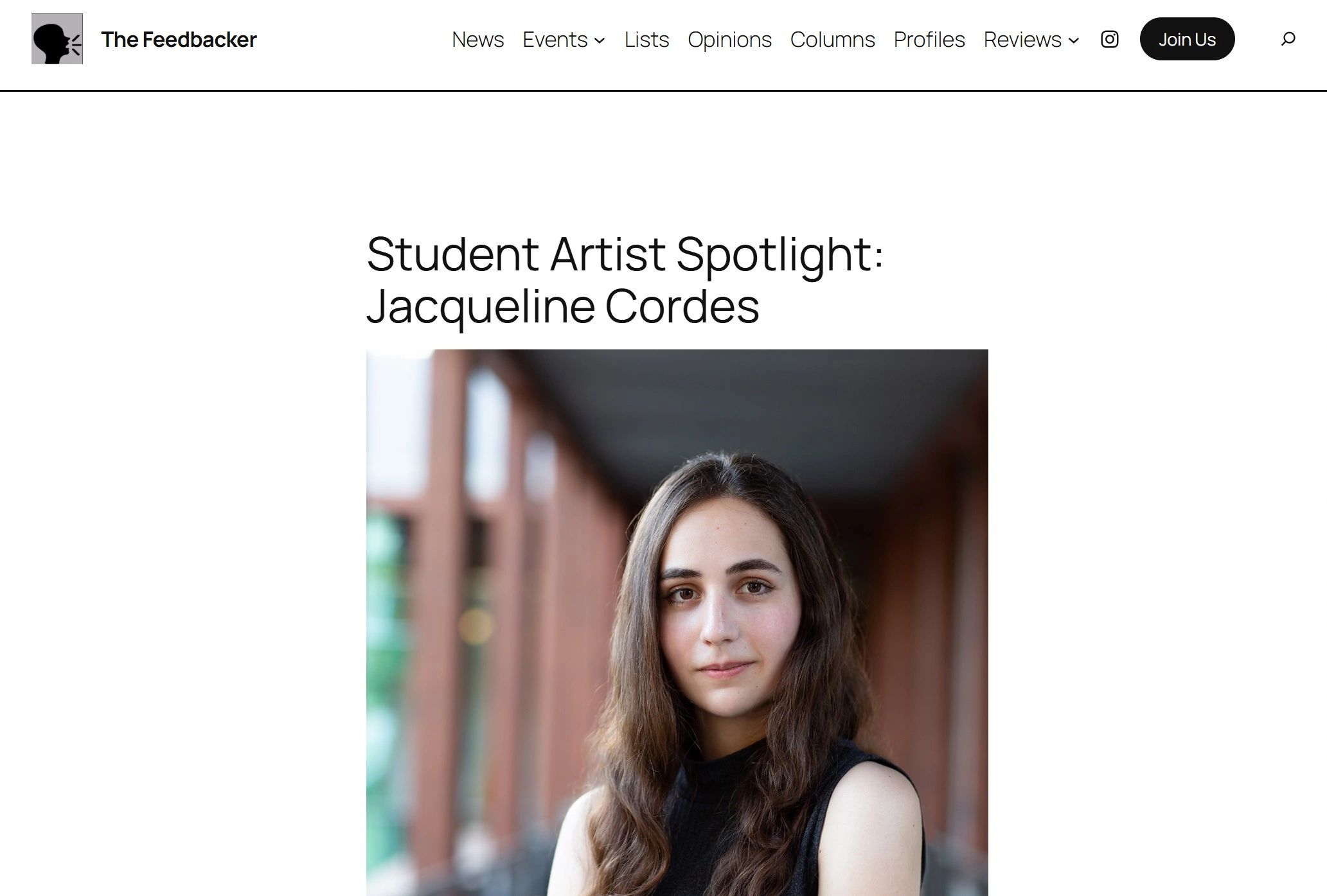
The Feedbacker
Student Artist Spotlight: Jacqueline Cordes
I first met Jacqueline in the basement of Pomona’s Thatcher music building. I had just finished playing a wobbly cover of Radiohead’s “Exit Music (for a Film)” when I heard an incessant knocking at the door.
Pulling it open, I found myself face-to-face with a girl from the practice room next door. She was wearing a silver Radiohead pendant around her neck and was smiling from ear to ear.
“I just need to say, I love Radiohead,” she said. “This is going to sound weird, but do you happen to experience colors when you listen to their music?”
Jacqueline, a music major in her senior year at Pomona, is herself no stranger to this phenomenon. She’s had synesthesia — a neurological condition that allows people to experience multiple senses simultaneously — for her entire musical career.
“I first realized I had synesthesia in general when I was eight,” Jacqueline later told me. “I was so excited to turn eight years old, because the number eight is a very pretty teal.”
A synesthesia battery test confirmed that she was a synesthete, although it wasn’t until her sophomore year of high school that Jacqueline discovered her musical chromesthesia. She was in the midst of playing Rachmaninoff’s Prelude in G Minor when the realization hit her.
“I just had this thought, like, this piece is so insane,” she said. “It changes straight from deep red to blue and green. And then I was wondering, is this another kind of synesthesia that I have?”
Jacqueline’s chromesthesia allows her to see different colors when she hears music. The Game of Thrones theme song is a medium red color. One of her favorite pieces in Edward Scissorhands is vividly light blue. “Hey There Delilah” is yellow. Jacqueline, who made the accompanying graphic, said that Radiohead’s music creates especially unique colors; she draws a lot of inspiration from them.
But according to Jacqueline, her chromesthesia does more than just influence how she hears other artists’ music; it also helps her shape her own compositions.
She’s been composing music since she was ten years old, but she started releasing her pieces online in her junior year of high school. Now, as a college student studying music, she spends nearly all of her time composing.
“I’m pretty much composing constantly,” she said. “If I’m not by an instrument, I’ll just sing into an audio memo so that I won’t forget, and I’ll write things down in my notes on my phone.”
Jacqueline mainly writes instrumental pieces, describing her compositional style as a blend of neo-classical new wave, ambient, cinematic, and gothic classical music. She draws inspiration from artists and groups like Danny Elfman and Radiohead, using her work to create new musical worlds.
She released her debut commercial album, Singularity, in 2024, although she started working on some of the pieces as early as the year before. Each piece underwent a vastly different creative process, with Jacqueline thinking up one of the songs in a lucid dream. She had been trying to write an “orange piece” for awhile, but hadn’t had any luck.
“In a lucid dream, I basically created this color radio with all these colored buttons on the top, with the idea that each of those represented a station where a piece of that color was being played,” she said. “And then I pressed the orange button, and the main theme of ‘Amber Sky’ came out.”
Singularity has ten tracks in total, all of which are meant to help listeners envision a different kind of world.
“I definitely hope that people experience the album as a collection of musical worlds,” she said. “I want them to feel like they’re basically being teleported to another time or place.”
Jacqueline’s next album is set to come out sometime in the next few months. In the meantime, she’s beginning to think about life after graduation.
“I would love to write soundtracks for films that are just, you know, slightly bizarre, slightly creepy,” she said. “I just think writing for films that have a very unique feel to them, a very unique environment — I would totally thrive.”
As for other aspiring musicians, Jacqueline has one major piece of advice.
“Write music for yourself,” she said. “Don’t write it trying to be popular, trying to match the style that someone else did. Definitely just write music that has value to you.”
Read the full interview →Interviews
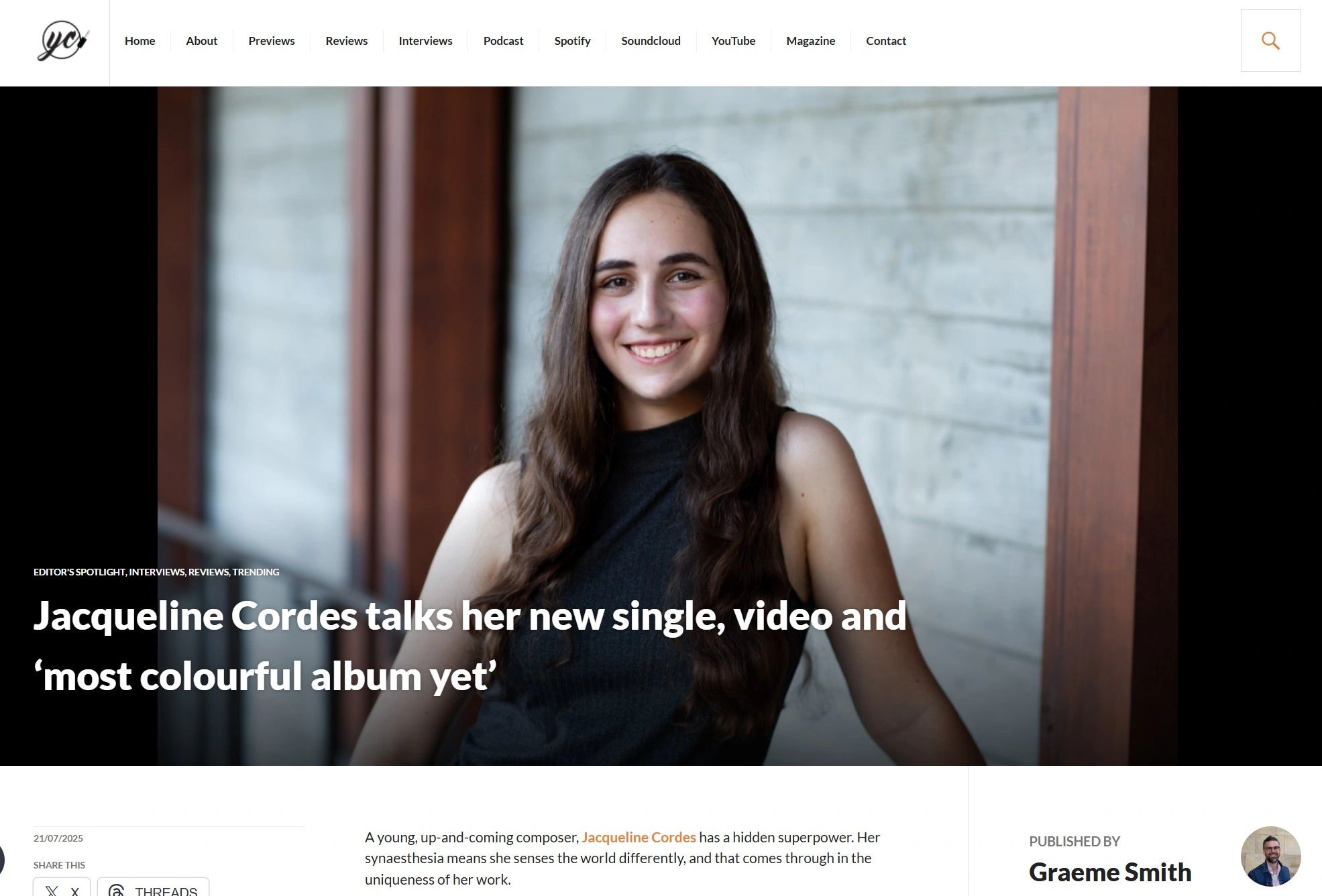
 York Calling
A young, up-and-coming composer, Jacqueline Cordes has a hidden superpower. Her synaesthesia means she senses the world differently, and that comes through in the uniqueness of her work.
“My synaesthesia definitely comes into play often while composing,” she says of her ‘superpower.’ “For one thing, I always know if I’m changing the musical feel in the middle of a piece, since the colour will change or disappear. I also think the colours encourage me to create a variety of musical environments and even sometimes write in genres I never would have thought to write in otherwise.”
It was at the end of 2024 that we first featured her music through her dark and atmospheric album, Singularity. Now she’s back with a new piece called Illusions of Amethyst, taken from her upcoming album, Frozen Star. I asked her how it was conceived and recorded.
“Even before I wrote a note of Illusions of Amethyst, I knew I wanted it to be purple,” she says. “I’d written down in my song ideas list to write a purple piece for choir and orchestra, with bells in the background and an overall magical sound to it.
“For most of the tracks on both Singularity and Frozen Star, I’ve been designing what I want the musical atmosphere to be like before I start writing, and then I bring those musical worlds to life one by one without needing inspiration from movies or books like I used to,” says Cordes. “For recording my tracks, I use Logic Pro, Cinematic Studio for the orchestra, and the choir is made up of many overlayed recordings of my voice.”
A suitably cinematic composition is paired with a narrative-driven video. While the instrumental is rich with a looping piano melody and ghostly vocalisations, the video unfolds showing a puppeteer putting the finishing touches on his creations. Like Pinocchio, one comes to life and we see the world through their eyes.
All the while, Cordes’s music stirs, bringing to mind the Gothic wonder of a Danny Elfman soundtrack. Things end low and lingering as the final twist in the video’s tale is revealed.
On the video, Cordes says: “I’ve always loved creating stories. To this day, I come up with stories every night while going to sleep, and it was the same process coming up with this narrative. As for why creepy puppets, let’s just say I have a seven-foot-tall horror animatronic at home, so it’s just very me.
“Putting the video together was challenging, and working with AI to create something like this is much harder than one might think. It took me hundreds of generations just to create a three minute video; 95% of it was complete nonsense. I often needed to edit photos in Photoshop and feed it back into the system to deal with things like ‘the six-finger problem’ – that would make a great band name, by the way. My upcoming video is more ambitious, and I’m finding I need to scrap an even higher percentage of it.”
The track and video proves a compelling taste of what’s to come from Frozen Star, and Cordes was only too happy to talk about the album.
“Frozen Star is my most colourful album yet, with eight different colours!” she exclaims. “And of course, each of the tracks creates a specific musical atmosphere. Listeners will laugh, they’ll cry, and they’ll get spooked."
“Singularity was a journey across time, ranging from the ancient past to the future, while Frozen Star is a journey through colour. I like to think of them as two halves of a double-album that introduces listeners to the Chromaverse and takes them on a tour of distinct musical worlds.”
Music composition isn’t the only string to Jacqueline Cordes’s bow and I asked her about her other talents, and what she ultimately hoped to do with them.
“My dream is a career in film music, but I do have an endless list of other interests,” she says. “For example, sooner or later, I plan to finish and publish a manga-style graphic novel that I’ve been working on for years. It takes place in the year 2086, and my friends joke that by the time I finish it, it will be about the present day.”
In the nearer future, she’ll be releasing an official soundtrack for a short film called Three Angles. She’s also planning on creating full music videos for all of the tracks on Frozen Star and Singularity.
“I can’t stop writing music,” she adds, “so I’m already getting started on my third album, which will be my first that’s completely made up of songs – with actual singing and lyrics. I’m not sure what to call the album yet; if it’s anything like my past albums, maybe I should go with Get Spooked.”
I’m certainly looking forward to hearing it. In the meantime, we can have our whistles whetted for Frozen Star by Illusions of Amethyst. The track is out now and you can give it a listen below.
Interviews
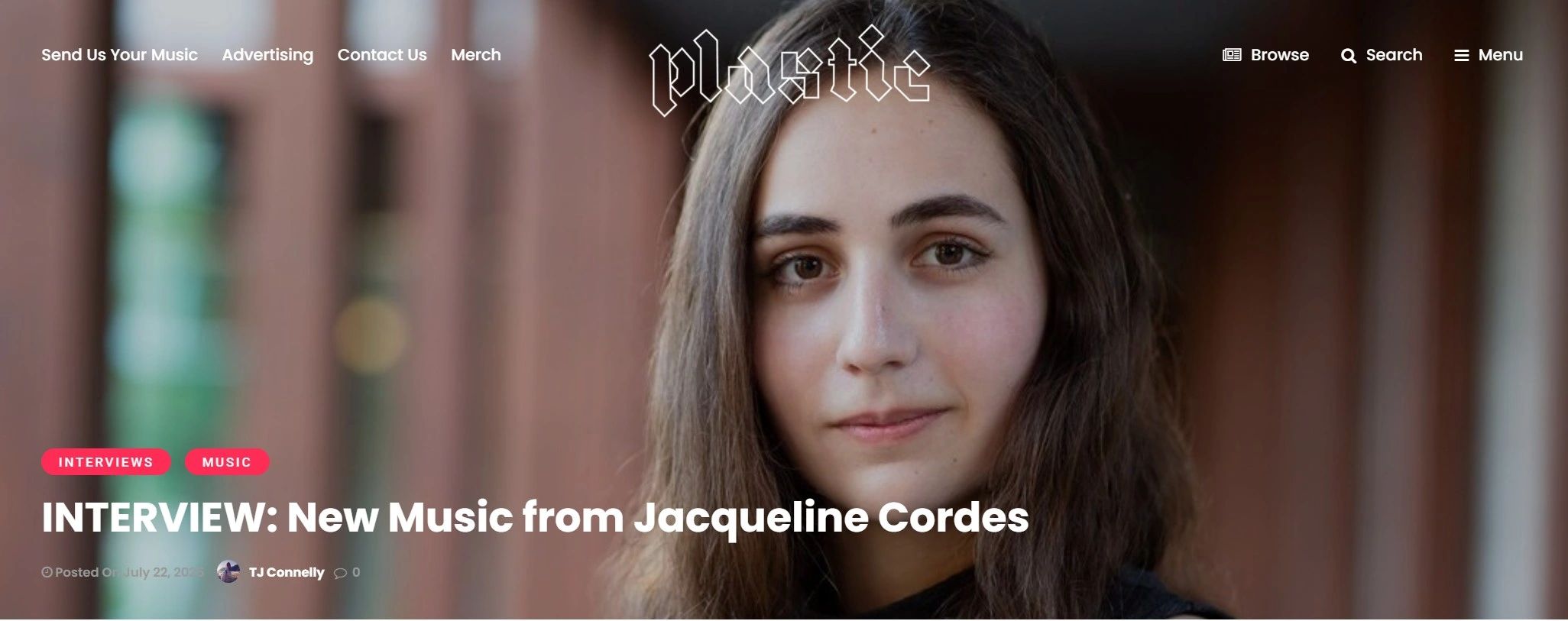
 Plastic Magazine
Los Angeles-based Jacqueline Cordes is no ordinary composer; she blends classical training with a vivid and highly personal approach to music based in synesthesia, the neurological phenomenon where sound is experienced through colour. This sensory interplay is no longer just a quirk of perception, it’s become the driving force behind her compositions. What was once a hidden detail of her experience has turned into a trademark, shaping the way she builds entire musical worlds.
With influences ranging from Danny Elfman and Radiohead to Depeche Mode and Trent Reznor, her work shines in a space that fuses cinematic drama with experimental sound. It’s a balance between mood and structure, emotion and technique. Her background in film scoring and formal composition gives her the tools to construct immersive pieces, while her chromesthesia gives each track its own spectral identity.
Her debut album Singularity, released last June, introduced listeners to her musical vision across ten tracks which saw Jacqueline mapping out a multidimensional sonic universe, carefully layering emotion, tone and visualised colour. The album’s release also coincided with her appearance at the 21st Fibonacci Conference at Harvey Mudd College. There, she presented her unique method for identifying and cataloging musical scales, offering insight into how chromesthesia can translate into formal musical systems.
Now she’s preparing to unveil her sophomore album Frozen Star, a companion piece to Singularity and an even more colourful plunge into what she calls the Chromaverse. Each album serves as a different passage through this vibrant, imagined dimension, distinct sonic landscapes crafted with storytelling themes and visual wonder. The first glimpse of this new chapter comes with the release of the lead single “Illusions of Amethyst,” a track that opens in minor key elegance and slowly develops into something darker and more hypnotic.
From the hushed flutter of piano tones and steady plod of bass notes, the piece blossoms of sting textures and airy vocalisations, adding sweeping choral vibes as the piece floats through a stunning orchestral soundscape. Flowing through passages of playful staccato bounce, graceful runs and surging energy, it’s a thoroughly engrossing listening experience from start to finish, showcasing her astonishing creativity and compositional talent.
Like with all her musical works, this track conjures a specific colour for the artist, this time taking on a hue of purple, invoking similar shades to Stephen Flaherty’s “Once Upon a December” or Schubert’s “Gretchen am Spinnrade.” With Frozen Star on the horizon, she continues to explores the fringes between sound and vision, story and sensation. We caught up with Jacqueline Cordes to find out more about her musical journey so far, her new single “Illusions of Amethyst” and what she’s got lined up for the future. Check out our interview with Jacqueline Cordes below.
Hey Jacqueline, how’s things?
Things are good! I’m keeping busy scoring a short film called Three Angles and promoting my upcoming album Frozen Star, so I’m doing what I love!
What’s your earliest memory of making music?
One of my earliest memories writing music is of the panic I experienced when I couldn’t remember a piece I had written. I was about 10 years old and I had forgotten that the melody started before the one-beat, which made it basically impossible to stumble across by chance. It eventually came back to me and gave me the valuable lesson to always record my sketches!
How do you find inspiration for your music?
I used to read books or watch movies for inspiration. I’d annoy my friends and family by bolting out of the room right when a movie ended to run to the keyboard, put on headphones, and play for about half an hour while I was still under the spell of the film. Thankfully, I don’t need to do that anymore and can basically choose a musical environment from my list of ideas and just get to work.
I also get a lot of help from a phenomenon I experience called synaesthesia. My subconscious mind associates colours with many things, and the type that’s most beneficial to my profession is an association between musical atmospheres and colour, so I can always tell when I’ve lost the feel of a piece.
What’s been your highlight for the year so far?
The highlight so far has to be meeting one of my biggest musical inspirations, Danny Elfman. I’ve been wanting to ask him for years whether he also has synaesthesia, since he’s second to Radiohead in terms of having the widest variety of colourful pieces. It turns out that he does not have it, which kind of blows my mind, because it’s like finding out that an incredible painter is colourblind!
What would you say is the perfect setting for listeners to enjoy your sound?
The perfect setting for my music would probably be anywhere that’s free of distractions so that listeners can be transported to the worlds my music is taking them to.
How has your own style and sound evolved since you started out?
My sound and style has become more orchestral and layered over the years. My pieces used to always start out as solo piano pieces, whereas nowadays, if I’m writing for orchestra, I don’t have to translate it from piano; I hear it as an orchestral piece from the beginning.
Who would be your dream artist to collaborate with?
My dream artist to work with would have to be Thom Yorke from Radiohead. (He’s the king of the syntesthetes). He’s made music in colours I haven’t been able to create yet, and I would love to learn what he sees in his mind’s eye.
How did you find making your new single “Illusions of Amethyst”?
Making Illusions of Amethyst was very fulfilling because an early version of it was actually rejected for a short film I was originally going to score; they decided to use music from Wagner instead. At first, I was disappointed, but quickly realised that this would allow me to develop the piece into its truest form without being limited by the visuals I would have to sync it up with.
What artist have you been listening to most recently?
Lately, I’ve been listening to a lot of Dead Can Dance. They were actually the first band I ever saw live when I was 10, and I enjoy them more now since getting my degree in music. Nowadays, I’m able to recognise the interesting musical modes they’re using and really appreciate the amazing environments they create.
What’s the main thing you want people to get out of listening to your music?
I just want listeners to realise that a vast variety of musical atmospheres can be created, even with relatively simple melodies and chord progressions. Many contemporary composers have veered off into experimental types of music, and I just want to convey that there is still plenty of room to explore using traditional instruments and musical scales!
What’s been your favourite live performance so far?
My favourite live performance so far would probably be The Smile, which is the Radiohead spinoff band with Thom Yorke and Jonny Greenwood. I saw them at the Shrine in L.A. and spent half of the concert in tears.
Do you have any advice for a new artist wanting to follow your footsteps?
It feels strange giving advice at only 22 years old, but I guess I’d say this: Use different musical modes or interesting scales. It’s amazing how far that will get you. Also, learn about counterpoint. You’ll never go back to guessing which harmonies sound good… the musical legends have figured out a lot.
Finally, what do you have lined up for the rest of the year?
Around the time Frozen Star comes out, I’ll also release the Three Angles soundtrack. I also have an academic paper coming out about synaesthesia, music, and scales that I’ll probably continue giving talks and concerts about. As soon as I’m done with the short films I’m working on, I’ll get back to releasing music videos. Creating those are way too fun! Read the full interview →
Interviews
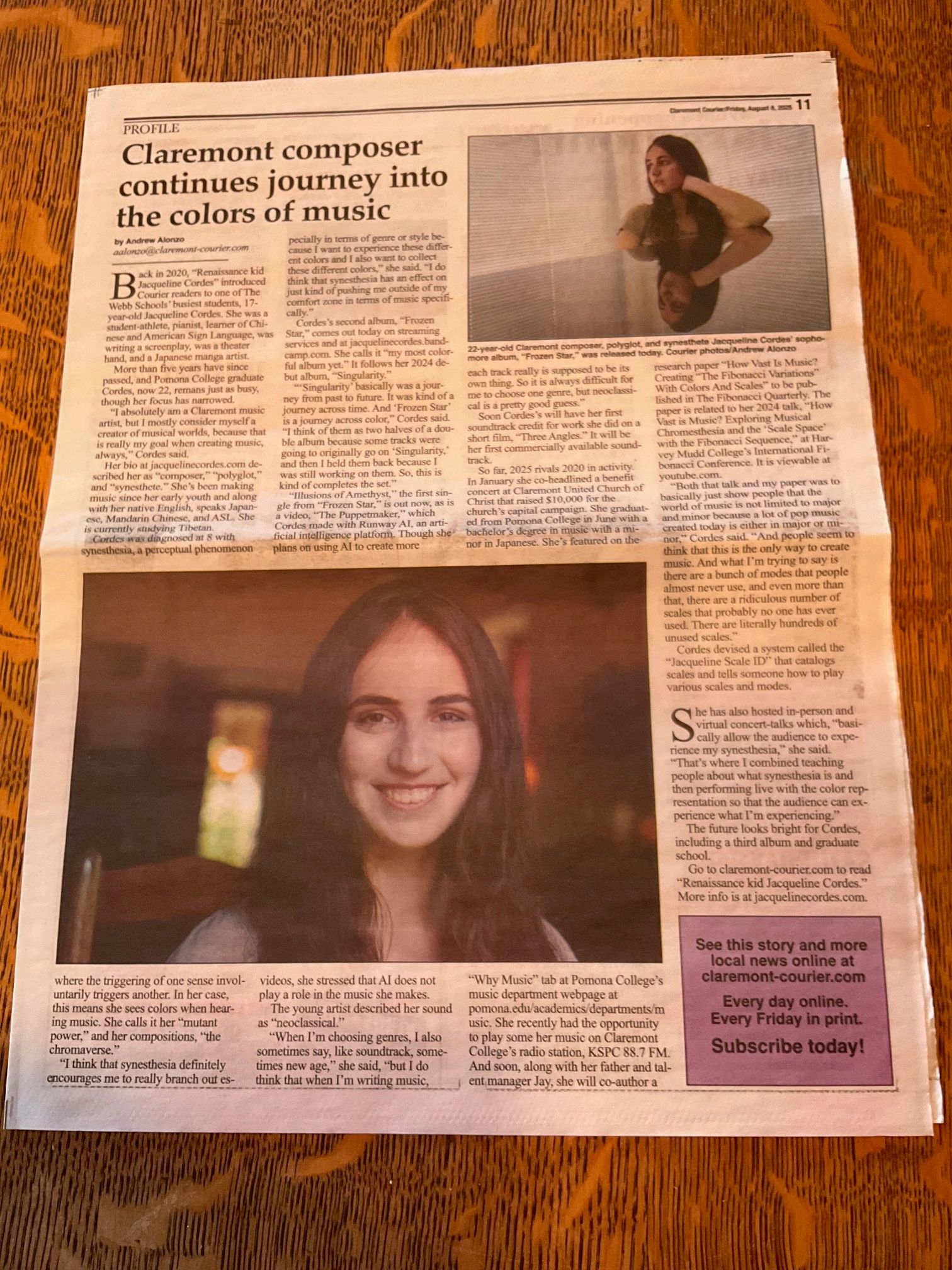
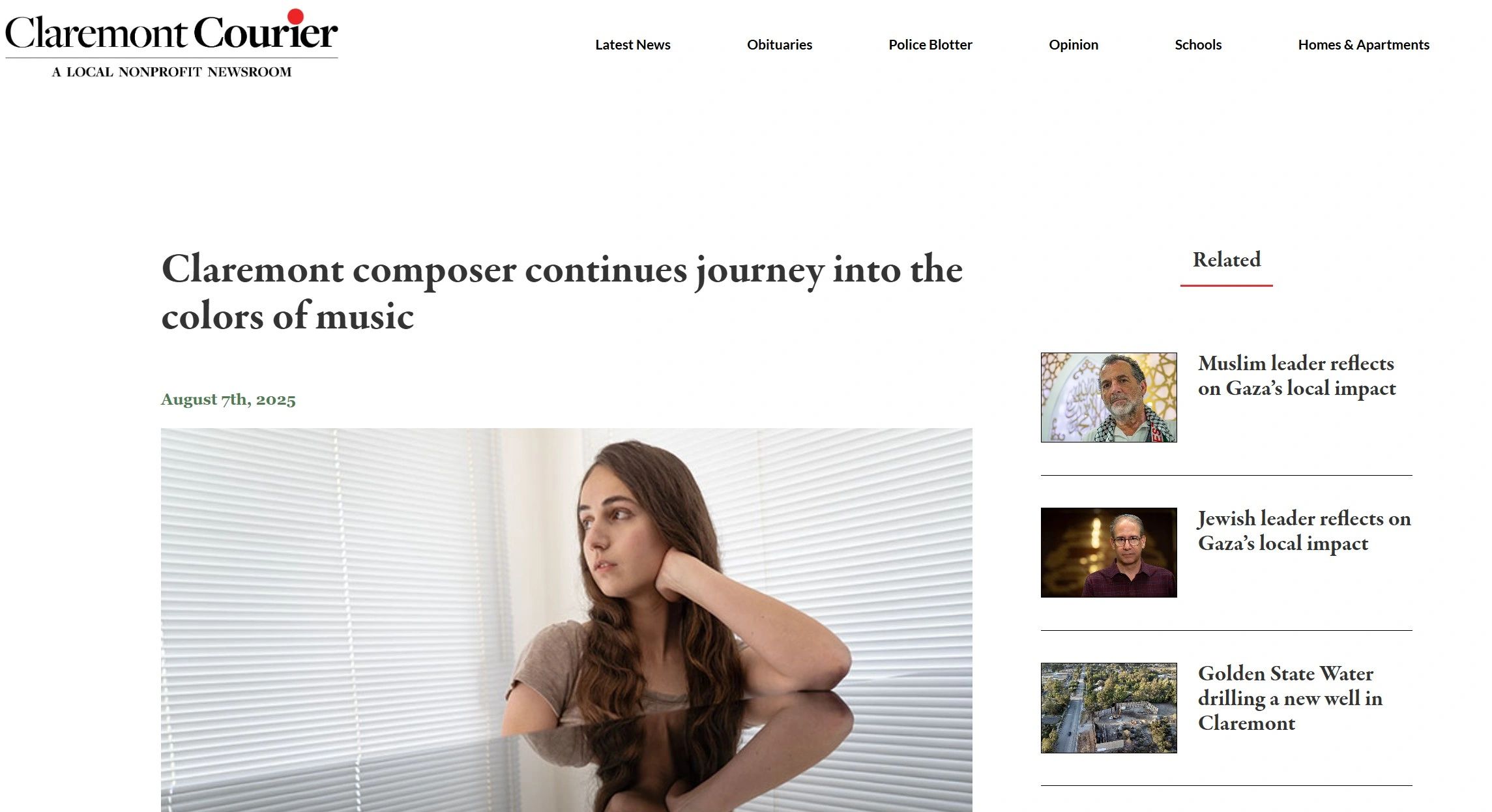 Claremont Courier
Back in 2020, “Renaissance kid Jacqueline Cordes” introduced Courier readers to one of The Webb Schools’ busiest students, 17-year-old Jacqueline Cordes. She was a student-athlete, pianist, learner of Chinese and American Sign Language, was writing a screenplay, was a theater hand, and a Japanese manga artist.
More than five years have since passed, and Pomona College graduate Cordes, now 22, remans just as busy, though her focus has narrowed.
“I absolutely am a Claremont music artist, but I mostly consider myself a creator of musical worlds, because that is really my goal when creating music, always,” Cordes said.
Her bio at jacquelinecordes.com described her as “composer,” “polyglot,” and “synesthete.” She’s been making music since her early youth and along with her native English, speaks Japanese, Mandarin Chinese, and ASL. She is currently studying Tibetan.
Cordes was diagnosed at 8 with synesthesia, a perceptual phenomenon where the triggering of one sense involuntarily triggers another. In her case, this means she sees colors when hearing music. She calls it her “mutant power,” and her compositions, “the chromaverse.”
22-year-old Claremont composer, polyglot, and synesthete Jacqueline Cordes’ sophomore album, “Frozen Star,” was released today.
“I think that synesthesia definitely encourages me to really branch out especially in terms of genre or style because I want to experience these different colors and I also want to collect these different colors,” she said. “I do think that synesthesia has an effect on just kind of pushing me outside of my comfort zone in terms of music specifically.”
Cordes’s second album, “Frozen Star,” comes out today on streaming services and at jacquelinecordes.bandcamp.com. She calls it “my most colorful album yet.” It follows her 2024 debut album, “Singularity.”
“‘Singularity’ basically was a journey from past to future. It was kind of a journey across time. And ‘Frozen Star’ is a journey across color,” Cordes said. “I think of them as two halves of a double album because some tracks were going to originally go on ‘Singularity,’ and then I held them back because I was still working on them. So, this is kind of completes the set.”
“Illusions of Amethyst,” the first single from “Frozen Star,” is out now, as is a video, “The Puppetmaker,” which Cordes made with Runway AI, an artificial intelligence platform. Though she plans on using AI to create more videos, she stressed that AI does not play a role in the music she makes.
The young artist described her sound as “neoclassical.”
“When I’m choosing genres, I also sometimes say, like soundtrack, sometimes new age,” she said, “but I do think that when I’m writing music, each track really is supposed to be its own thing. So it is always difficult for me to choose one genre, but neoclassical is a pretty good guess.”
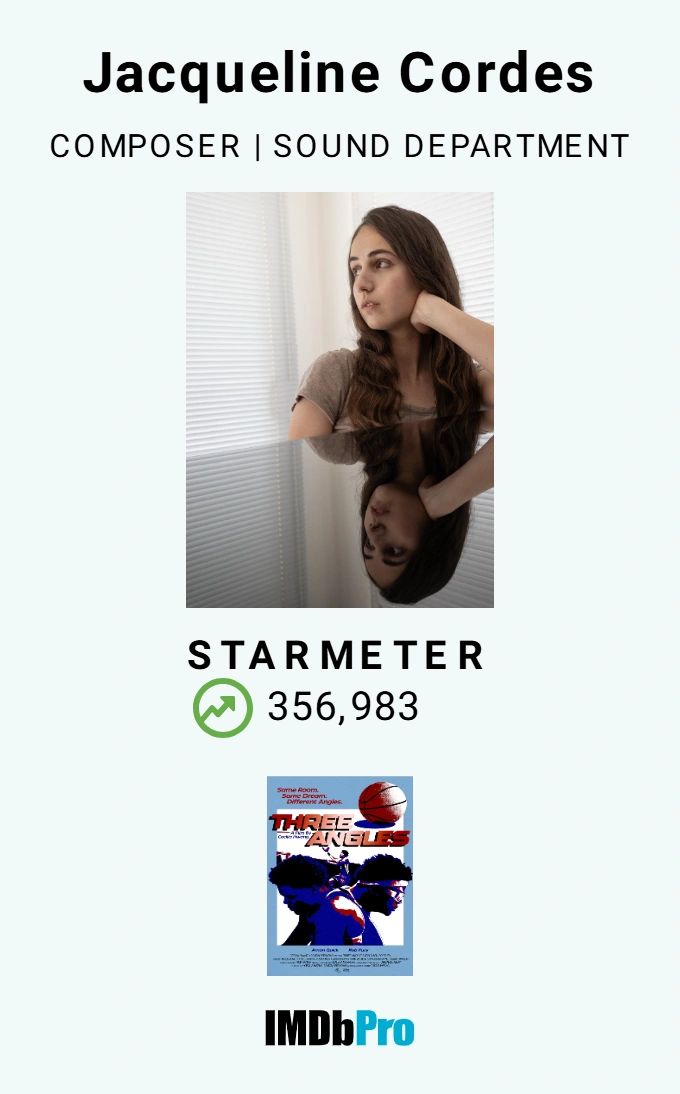
Soon Cordes’s will have her first soundtrack credit for work she did on a short film, “Three Angles.” It will be her first commercially available soundtrack.
So far, 2025 rivals 2020 in activity. In January she co-headlined a benefit concert at Claremont United Church of Christ that raised $10,000 for the church’s capital campaign. She graduated from Pomona College in June with a bachelor’s degree in music with a minor in Japanese. She’s featured on the “Why Music” tab at Pomona College’s music department webpage at pomona.edu/academics/departments/music. She recently had the opportunity to play some her music on Claremont College’s radio station, KSPC 88.7 FM. And soon, along with her father and talent manager Jay, she will co-author a research paper “How Vast Is Music? Creating “The Fibonacci Variations” With Colors And Scales” to be published in The Fibonacci Quarterly. The paper is related to her 2024 talk, “How Vast is Music? Exploring Musical Chromesthesia and the ‘Scale Space’ with the Fibonacci Sequence,” at Harvey Mudd College’s International Fibonacci Conference. It is viewable at youtube.com.
“Both that talk and my paper was to basically just show people that the world of music is not limited to major and minor because a lot of pop music created today is either in major or minor,” Cordes said. “And people seem to think that this is the only way to create music. And what I’m trying to say is there are a bunch of modes that people almost never use, and even more than that, there are a ridiculous number of scales that probably no one has ever used. There are literally hundreds of unused scales.”
Cordes devised a system called the “Jacqueline Scale ID” that catalogs scales and tells someone how to play various scales and modes.
She has also hosted in-person and virtual concert-talks which, “basically allow the audience to experience my synesthesia,” she said. “That’s where I combined teaching people about what synesthesia is and then performing live with the color representation so that the audience can experience what I’m experiencing.”
The future looks bright for Cordes, including a third album and graduate school.
Interviews
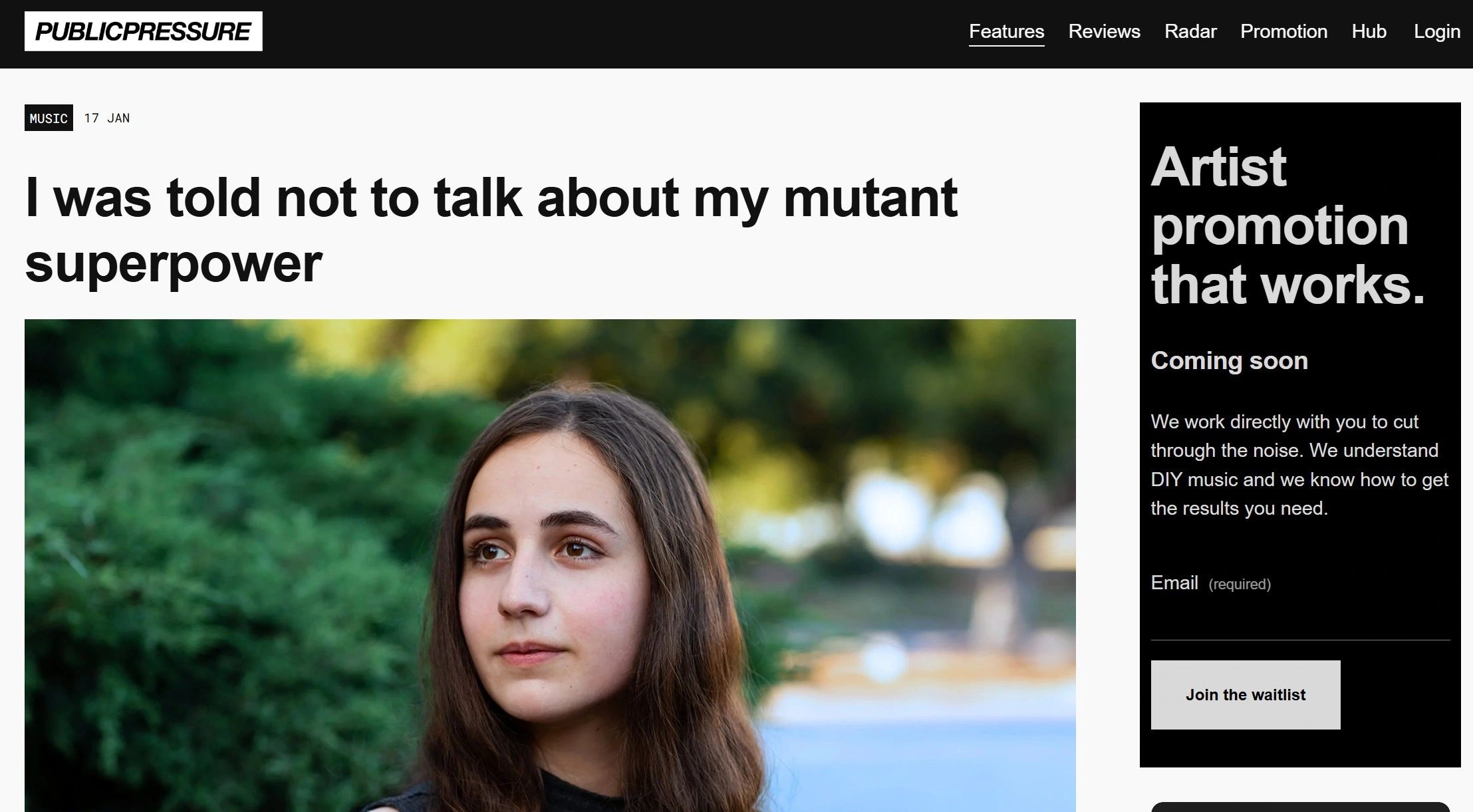
 Public Pressure
“As a child, I was told not to talk about my mutant superpower, so I kept it secret and hid among humans. Now, I'm putting it to use, creating colourful music in a variety of styles and environments and proving that even non-synesthetes can appreciate the variety of colours, even if they can't see them.”
Imagine perceiving sounds as bursts of colour, where melodies glow and harmonies shimmer in vivid hues. For Jacqueline Cordes, this isn’t a metaphor but her everyday reality. As a chromesthetic composer, she experiences music through a kaleidoscope of colours, using this rare neurological condition as a powerful creative tool. Whether crafting the vibrant worlds of her debut album “Singularity” or colour-coding film scores to evoke precise emotions, Jacqueline’s unique perspective transforms how she approaches music. In this interview, she shares how chromesthesia has shaped her artistry, from her discovery of the condition to her mission to explore uncharted musical environments and inspire listeners to see the world through her eyes.
Do you remember the moment you discovered your chromesthesia? What was it like to realise that not everyone “sees” sound the way you do?
I was in my junior year of high school, I was practising Rachmaninoff’s Prelude in G minor, and I suddenly thought, “What an insane piece—it changes from red suddenly to green and blue.” Then it hit me: “What if this is another kind of synaesthesia I have?” By then, I already knew I had grapheme-colour synaesthesia. I’d figured it out at eight years old, after telling my parents how happy I was to turn eight because the number eight is a lovely shade of teal. My parents had heard of synaesthesia but were sceptical until they researched it and found that most synaesthetes agree the letter A is red. My dad called out from the other room, “What colour is A?” and I yelled back, “Red!” After that, I took a synaesthesia battery test, which confirmed I was a synaesthete.
Like many synaesthetes, I was stunned to learn that most people don’t experience the world this way. I was also surprised to find that non-synaesthetes can imagine black numbers and letters! Realising how rare synaesthesia is made me feel fortunate—it’s profoundly influenced my passions and life path.
Can you share what certain musical elements—like a minor chord or a specific instrument—look and feel like to you? How does your chromesthesia inspire your music?
Unlike many synaesthetes who associate specific chords or instruments with colours, my chromesthesia is tied to the musical character or feel. For example, most Irish jig music and sea shanties appear red to me—energetic, driving, and often in minor keys. Green music, which is rarer, emerges in orchestral film scores with strong chord progressions and soaring melodies, often in dorian mode, like the main themes of “Black Beauty”, “Night at the Museum”, and “The Power of the Heart”.
This perception shapes my compositions. I aim for clear melodies and chord progressions, which are more likely to evoke colours. Understanding the musical elements that create certain colours is invaluable when composing. For instance, when scoring a film, I might think, “This scene needs a heroic and soaring theme—something green.” A filmmaker recently laughed when she noticed I’d colour-coded the script, saying, “You’re, like, supernatural!”
Was there a moment during your childhood or early musical education when your synaesthesia became a creative tool rather than just a fascinating quirk?
Once I began understanding what the colours represented, they started influencing my compositions by helping me replicate the environments of pieces that inspired me. When I began sharing my synaesthetic experiences with teachers and peers, I found that most people were fascinated and full of questions. Over time, it became a defining part of my identity.
When you sit down to compose, do you start with a musical idea and see where the colours lead you, or do you begin with a visual palette and translate it into music?
Most of the time, I aim to create a specific musical environment, focusing on evoking particular colours and using instruments to build the atmosphere I envision. Over time, I’ve learned to consistently create colours by understanding the necessary musical elements. For example, green pieces often revolve around repeating chord progressions, while purple pieces start with melodies that guide the chords. Unfortunately, some great music feels “colourless” to me, so I use unique scales or other techniques to build a vivid atmosphere.
At the Fibonacci Conference, you spoke about cataloguing scales. Could you tell me more about that?
My goal in cataloguing scales was to encourage other composers to explore the vast array of scales available in music. I wanted to make unusual scales accessible, even for those without formal music theory training, and inspire experimentation beyond major and minor scales. Popular music today feels increasingly homogenous, but scales are powerful tools that can evoke distinct musical worlds. I hope to inspire composers to explore this untapped potential.
Do you see your work as a bridge to help people understand chromesthesia, or is it more about sharing your unique perspective with the world? I aim to create music that captures specific musical worlds. My hope is that even non-synaesthetes can connect with my work and feel transported to another time or place. I’m constantly discovering new musical environments and hope to explore and document as many as I can.
Interviews
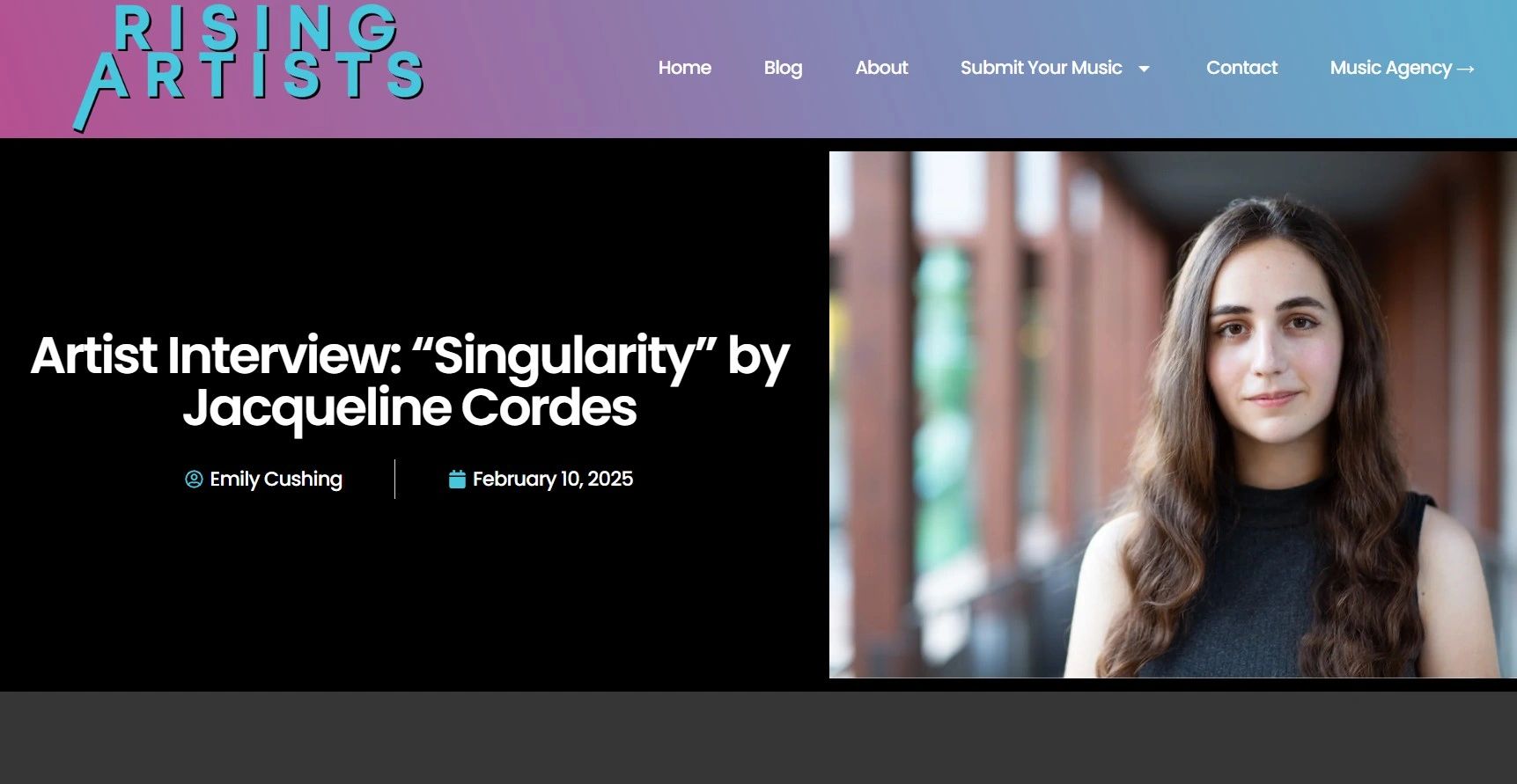 Rising Artists
How does your synesthesia interact with your creative process?
It definitely plays a large role. I think it helps me avoid getting so experimental with my music that it stops connecting emotionally with people. Colors seem to occur in that sweet spot between conventional and unpredictable. I think synesthesia also causes an awareness for when I’m changing the musical character in the middle of a piece; I can see when the color changes. If I change colors within a piece, it’s often an intentional decision for a contrasting section, rather than letting the color falter within a musical phrase, which I try to avoid.
“Singularity” is an ethereal instrumental album. What was your creative process in making these tracks?
I generally have different processes for each piece, but I’ll tell you my craziest one. I had been trying to write an orange piece for a very long time and couldn’t figure out how to do it. Since synesthesia is a subconscious process – it’s completely beyond my control and I don’t know what aspects cause each color – I decided to try to use my lucid dreams to help. During a lucid dream, I conjured a “color radio” in which each station (a set of colored buttons on the top) is playing a piece of the corresponding color. I pressed the orange button, and the main theme of the piece that eventually turned into Amber Sky (a synesthetically orange piece) began to play. I know it sounds crazy, but this is what happened!
Did any real-life events occur in your life that inspired “Singularity?”
Actually, no. I don’t tend to write about my own life in my music since my goal is to create new musical worlds rather than reflect on past experiences.
Do you have a personal favorite on the album? Which one, and why?
The tracks are really difficult for me to compare since they are all so different, but maybe my choice would be “Encounter From Beyond.” It was one of the pieces that was really effortless to write and also takes one of the most dissonant intervals–the tritone–and makes it palatable. That said, I think “A Child’s Song” really represents my typical musical style. It’s purple, which I write in often, and also has a spooky feel.
Was there a pivotal moment in your life when you decided to follow your path as a musician?
Yes. I originally planned on studying linguistics in college, but when I started taking music classes and especially music composition classes, I realized that composing music was what I truly loved both studying and doing in my free time.
What is coming up next for you?
Another album called Frozen Star! It will be out in a few months, and it will transport listeners to another collection of musical worlds.
“A stunning debut that connects classical artistry with contemporary creativity … it expands the limits of what music can accomplish.”— Dulaxi
“The music is sweeping, dramatic, and vivid enough to soundtrack entire worlds, and I found myself constantly surprised by the ambition that went into shaping it.”
— Pitch Perfect
“It’s a thoroughly engrossing listening experience from start to finish, showcasing her astonishing creativity and compositional talent.”
— Plastic Magazine
"There’s something almost alchemical about the way Jacqueline Cordes composes, a kind of sorcery that turns … emotions into landscapes, and songs into storybooks."
— The Indie Grid
“Singularity is an incredible experience that really cannot be missed. Jacqueline Cordes has created something truly special here, and it’s exciting to imagine where her creativity will take her next!”
— Space Sour
“Transports you to worlds you hadn’t planned to go to but won’t want to leave.”
— York Calling
“[Jacqueline has] … an incredible instinct for atmosphere.”
— Denson Camp, recording artist
"Her creative universe, dubbed 'The Chromaverse,' is an ever-expanding constellation of sonic worlds, each infused with color, narrative, and mood."
— Dulaxi
“Moves us into classical piano territory a la ‘Moonlight Sonata’ suffused with nightmare vibrations … the final voice will make the hairs on your arm stand up.”
— Pitch Perfect
“It’s an epic display of enveloping ambient music that captures a haunting aesthetic of truly gripping and mesmeric quality.”
— Plastic Magazine
“Merges classical discipline with cinematic atmosphere and imaginative storytelling.”
— Euphony Blognet
“Jacqueline Cordes proves herself to be an intuitive and detailed composer capable of captivating storytelling.”
— Each Measure
“Hauntingly ethereal and exquisitely graceful.”
— Savoy Truffle Tunes
“Reminds fondly of Danny Elfman’s scores … fit for both the big screen and more personal listening experiences.”
— Obscure Sound
“Fairytale theatrics, deeply expressive and moving, achingly beautiful. There is both a grandeur and boundlessness to it.”
— Apollo’s Harp
“Her synesthesia is her internal compass, guiding her toward emotional coordinates others rarely map.”
— Flex Music Blog
“Moving, immersive and poetic.”
— KIMU
“Jacqueline’s use of sound design is meticulous. The layered choirs give the piece an ethereal weight, while the violin passages carve through the mix with haunting lyricism. Every sonic detail feels sculpted to draw the listener deeper.”
— Loop Solitaire
“Her imaginative, complex, and yet highly approachable compositions have gathered favourable attention even on an academic level.”
— Less Than 1000 Followers
“It’s clear she’s shaping something immersive.”
— Hail Tunes
“Cinematic masterpiece”
— Pulse Hutch
Frozen Star Reviews
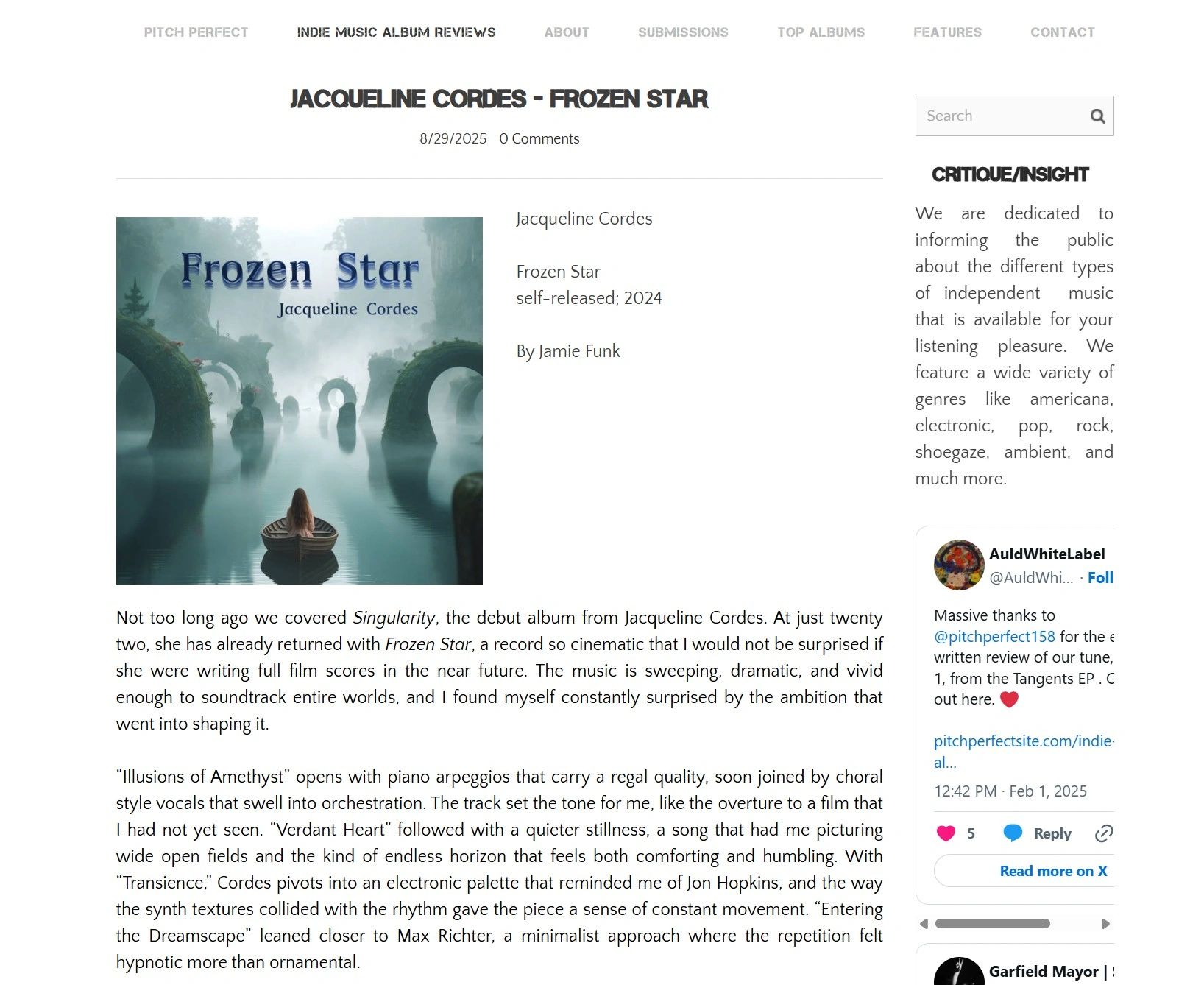
Pitch Perfect
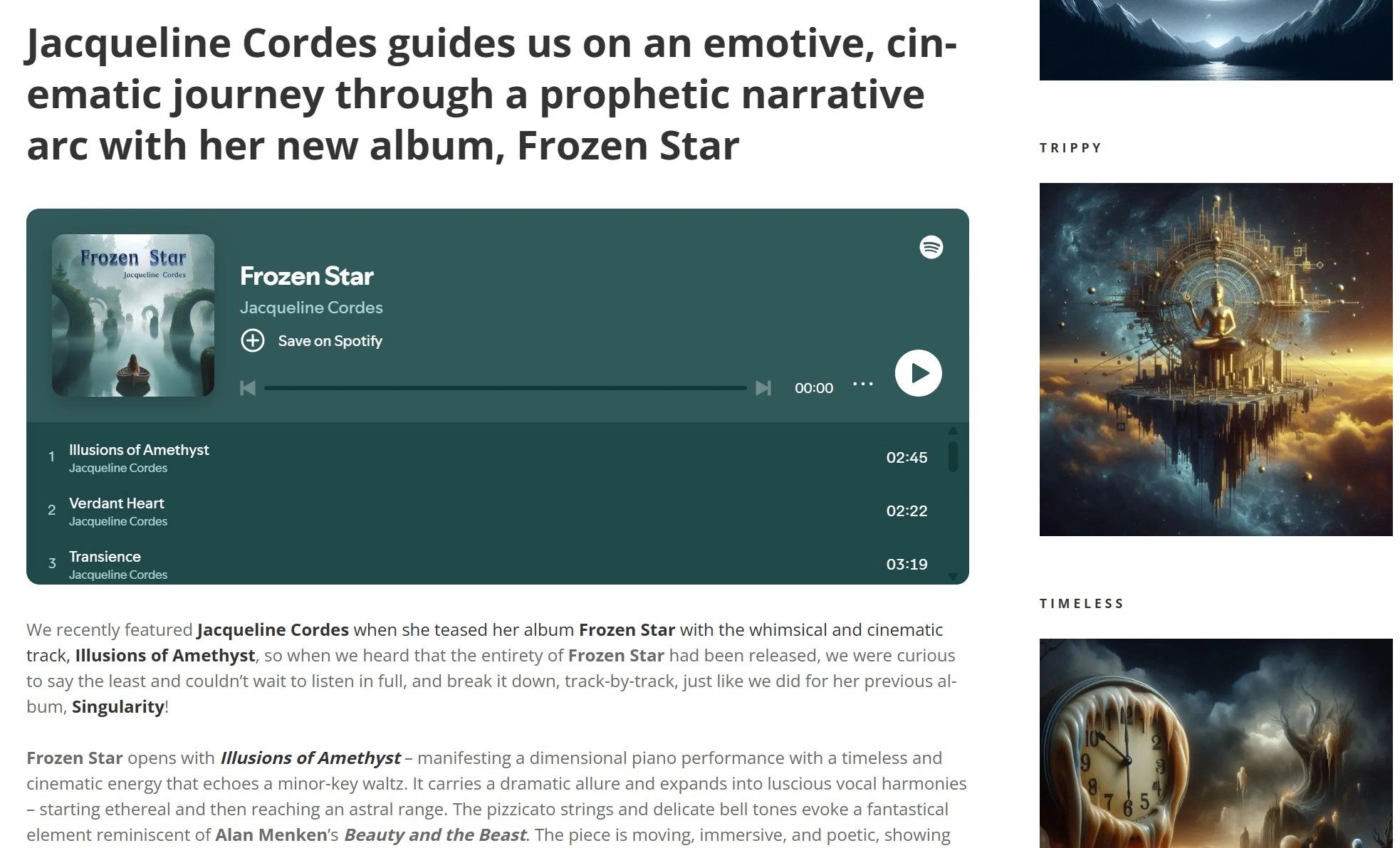
KIMU
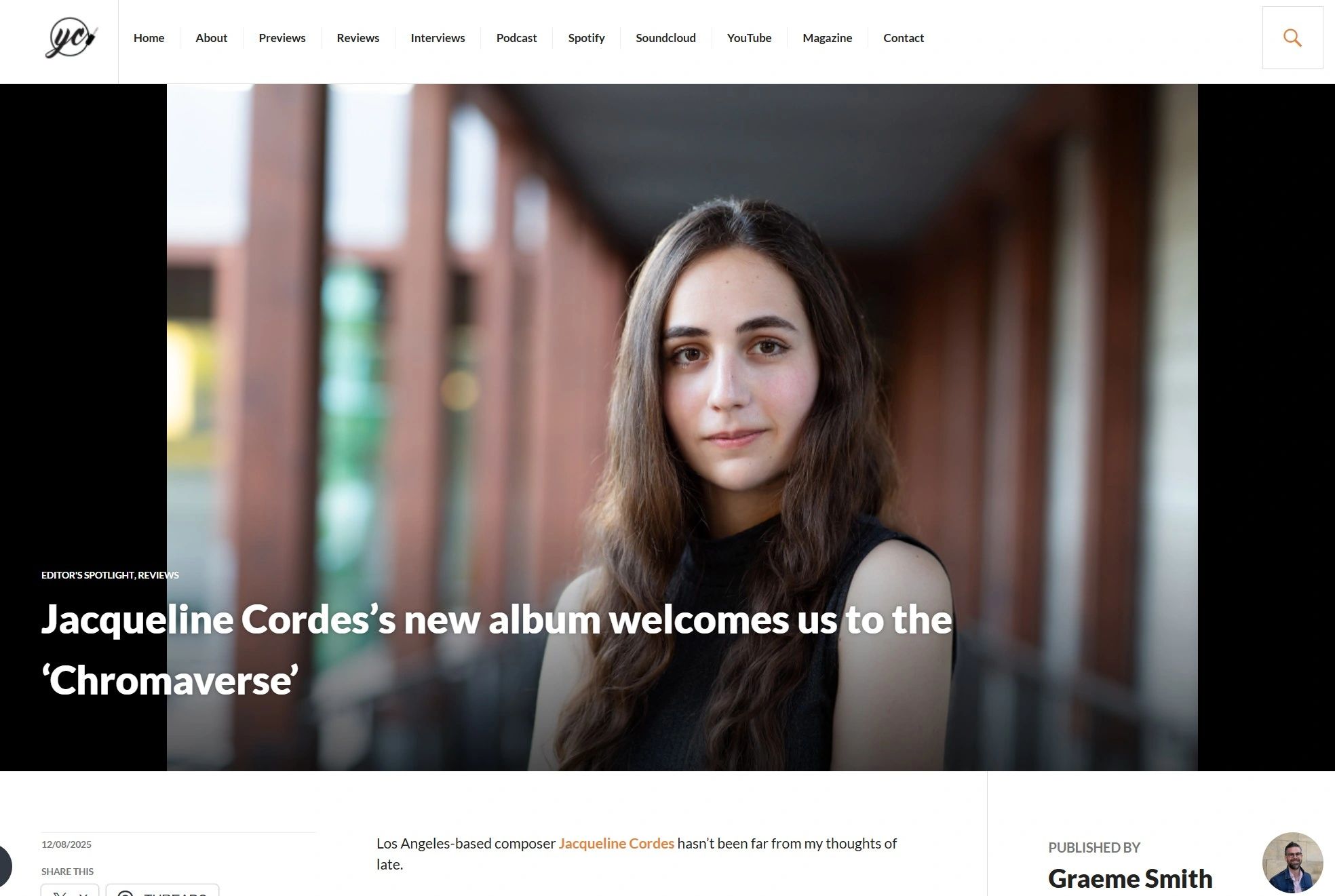
York Calling
Sinusoidal Music
Euphony Blognet
Dulaxi
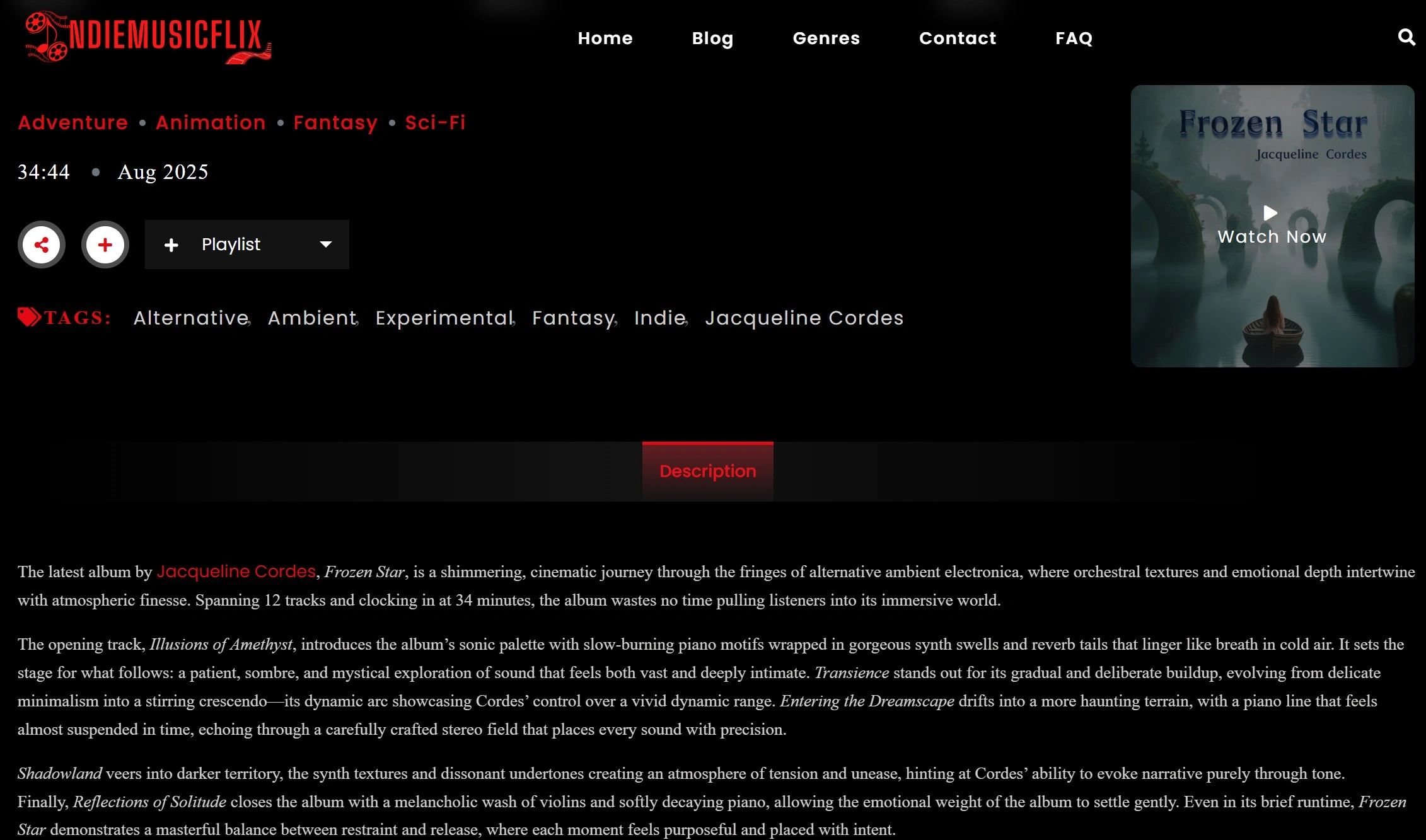
Indie Music Flix
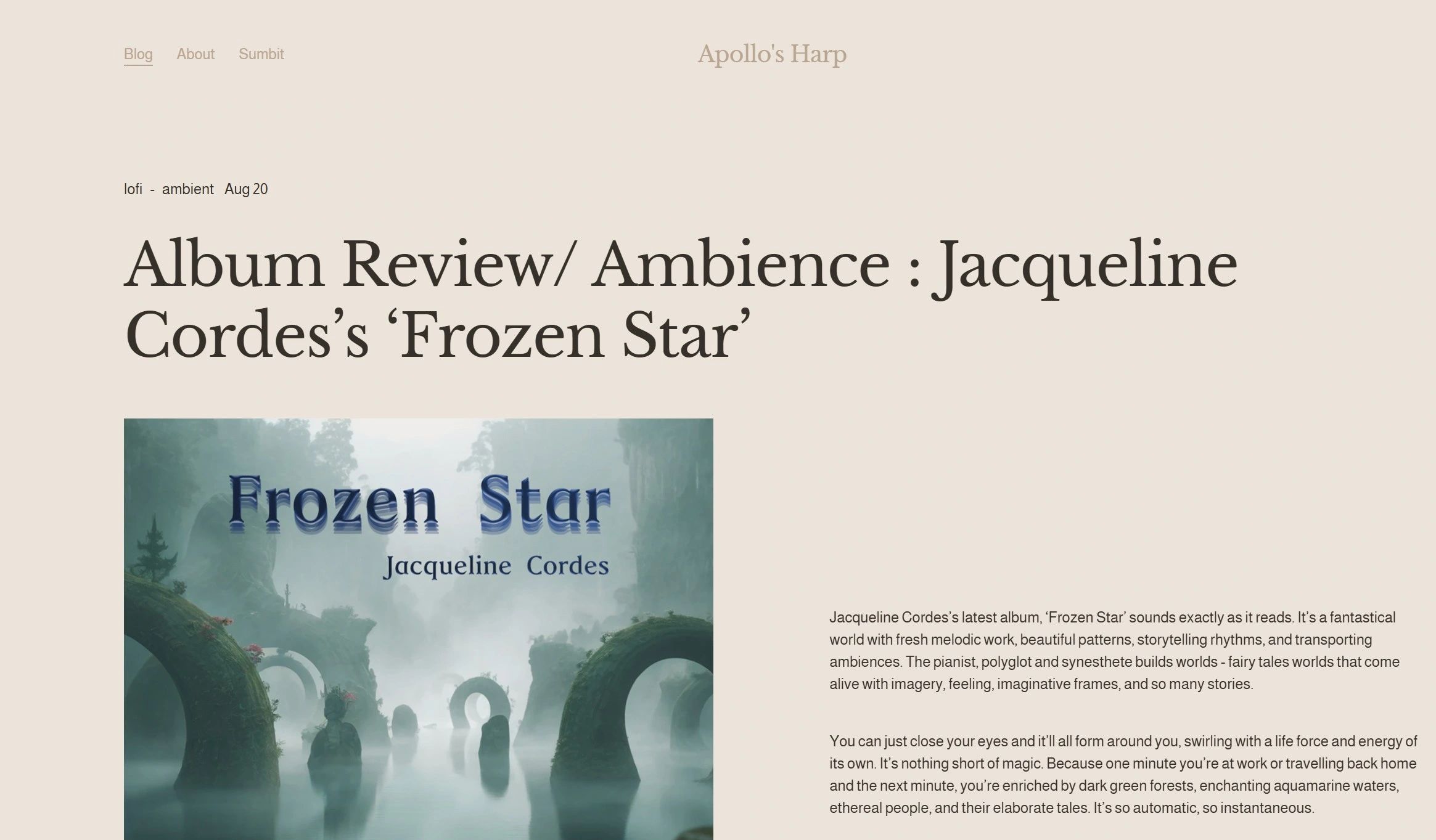
Apollos Harp
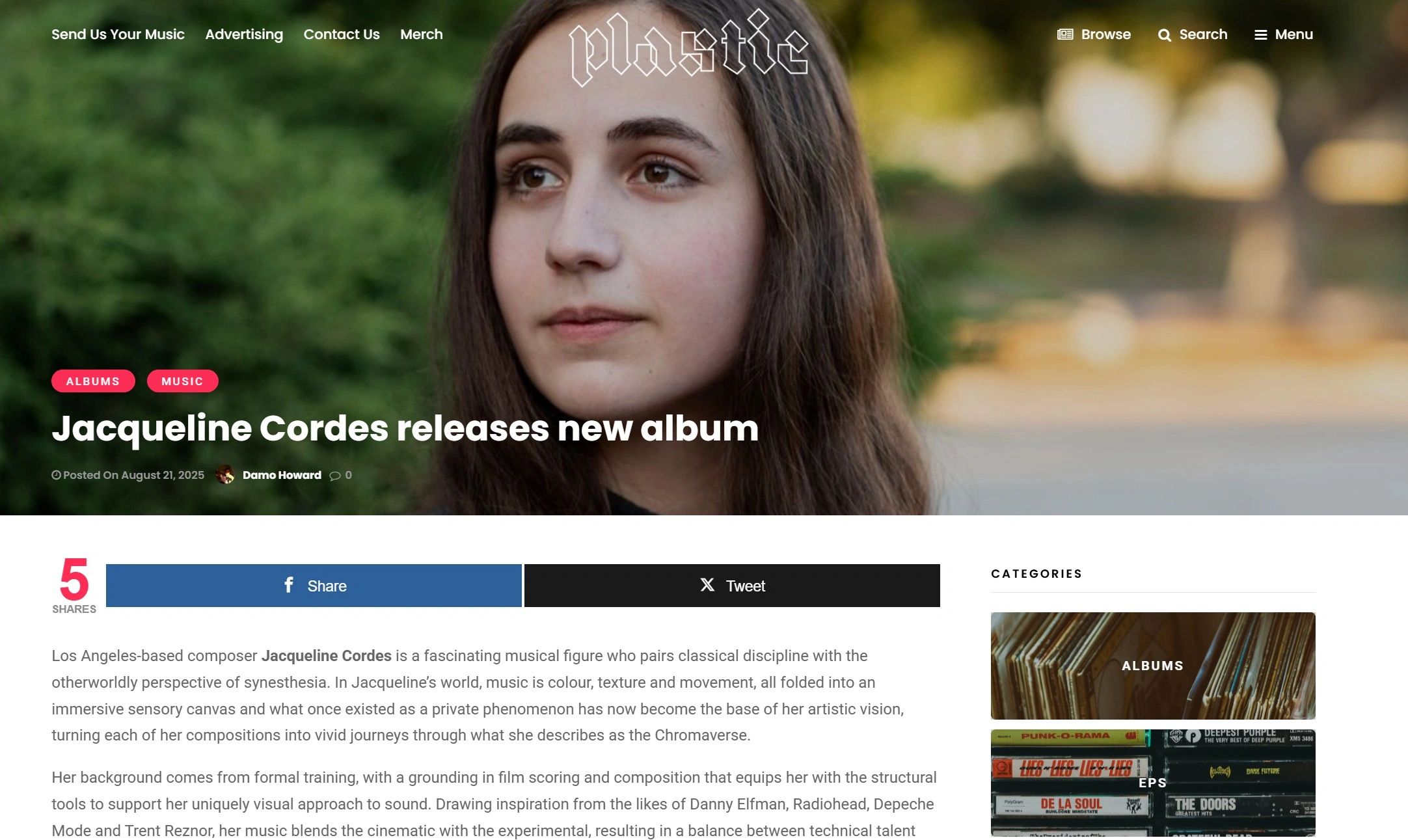
Plastic Magazine
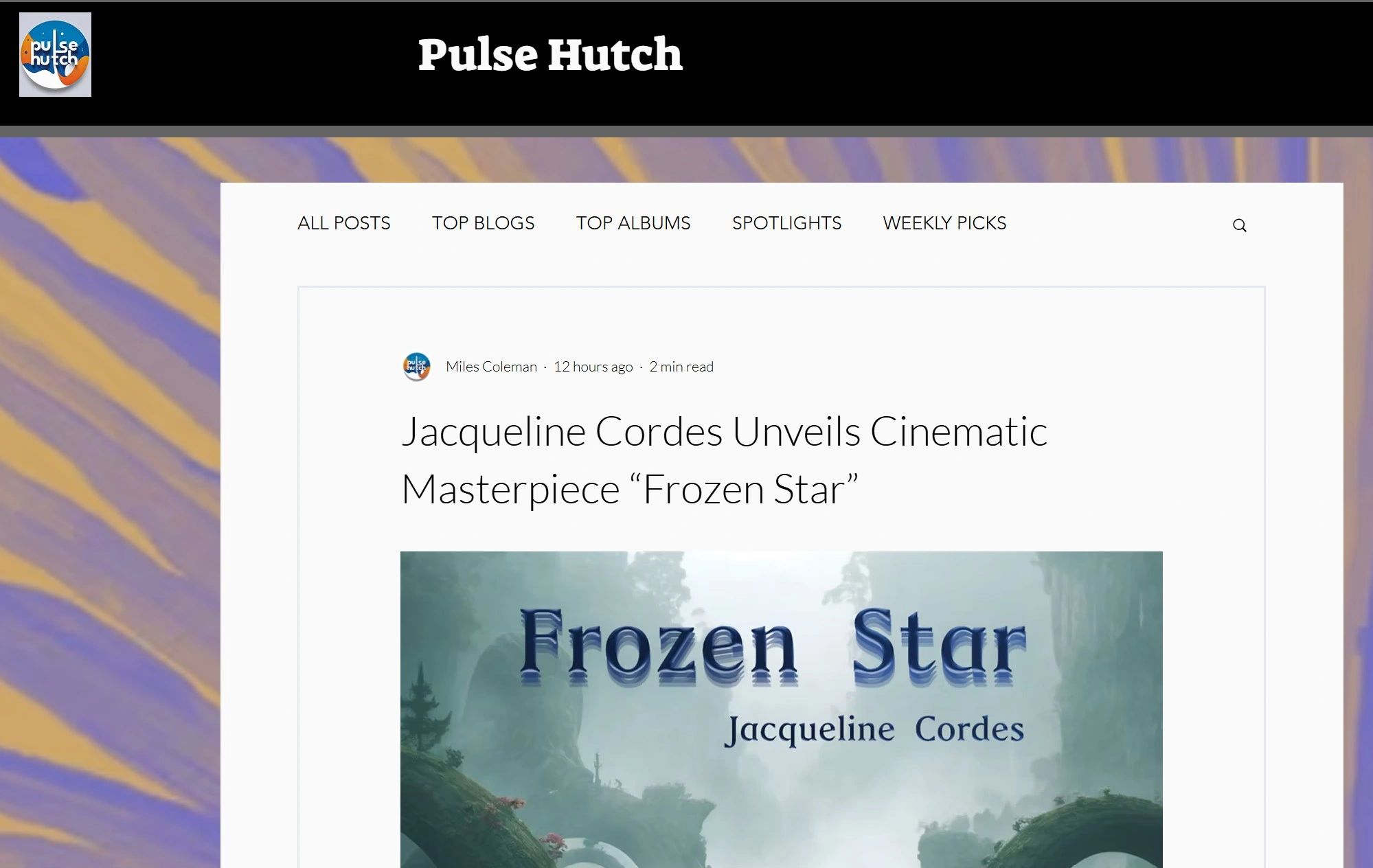
Pulse Hutch
Illusions of Amethyst Reviews
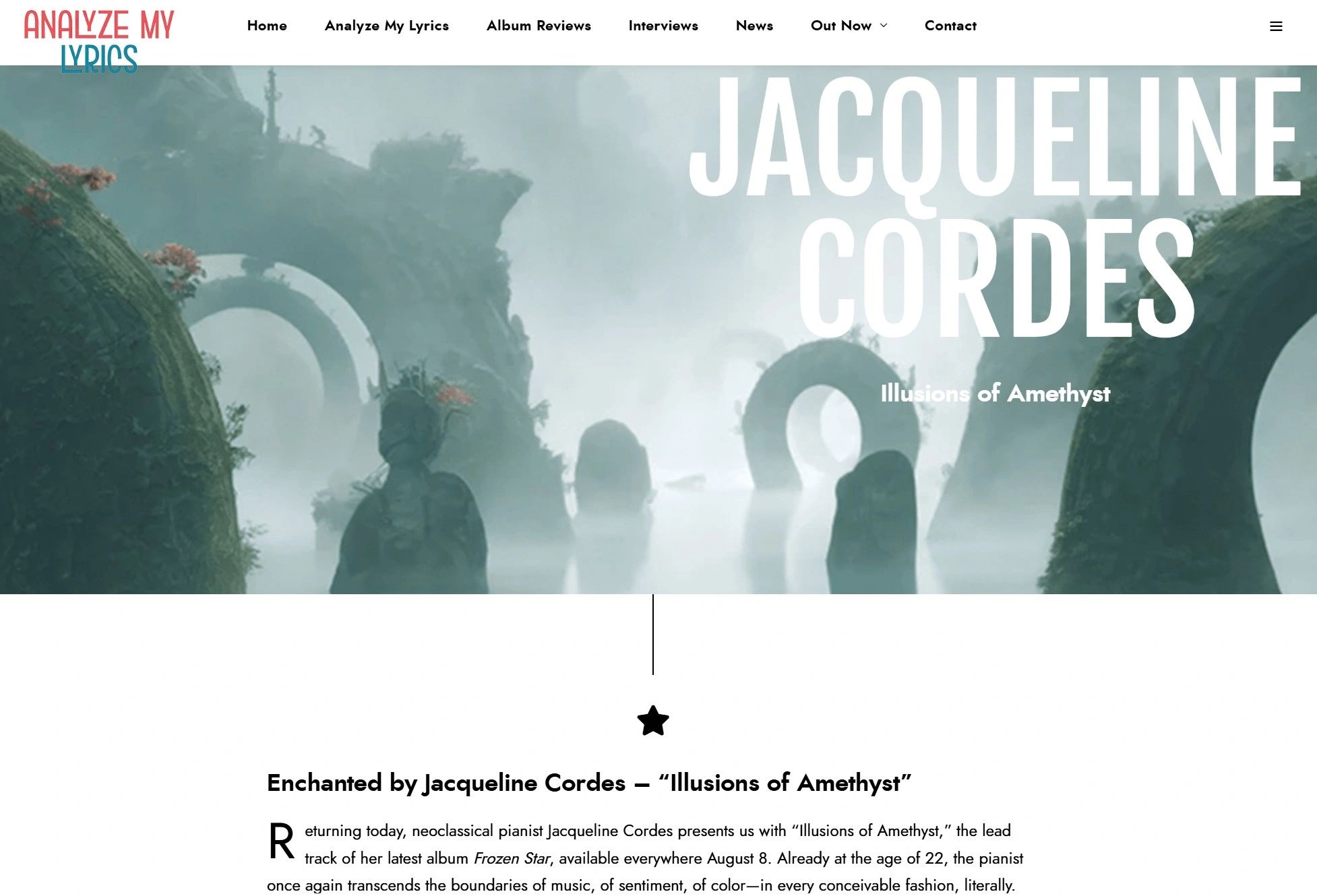
Analyze My Lyrics
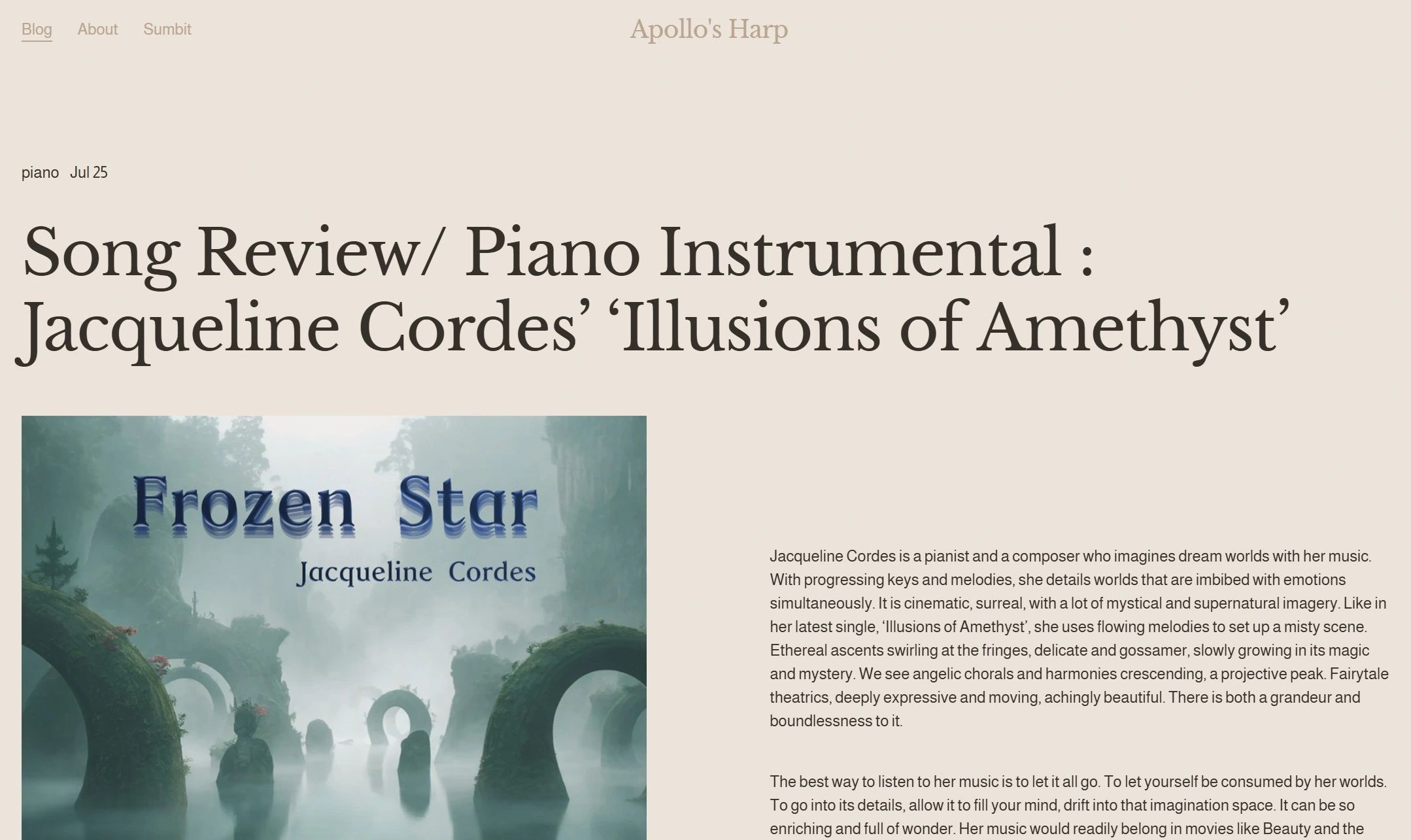
Apollos Harp
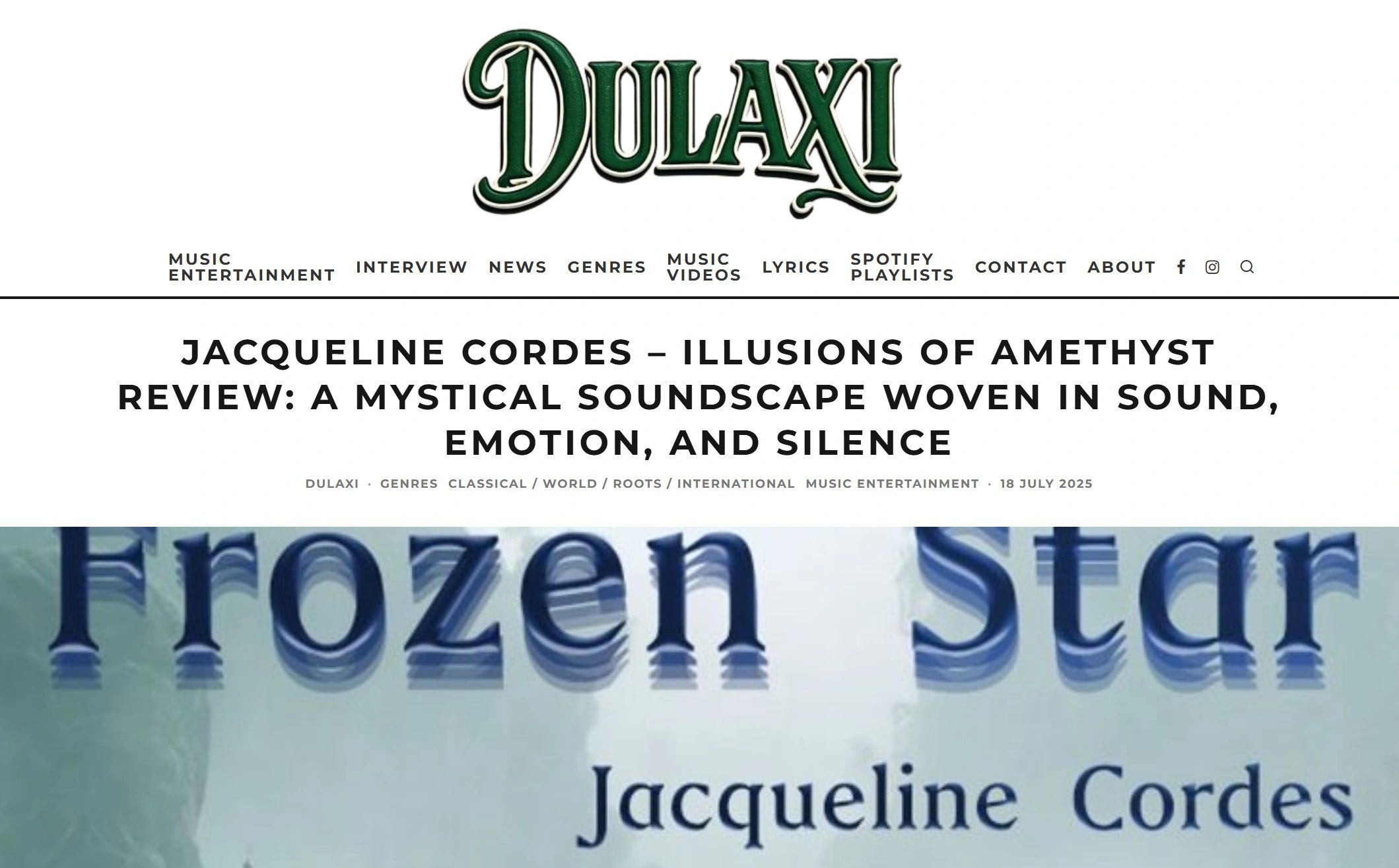
Dulaxi
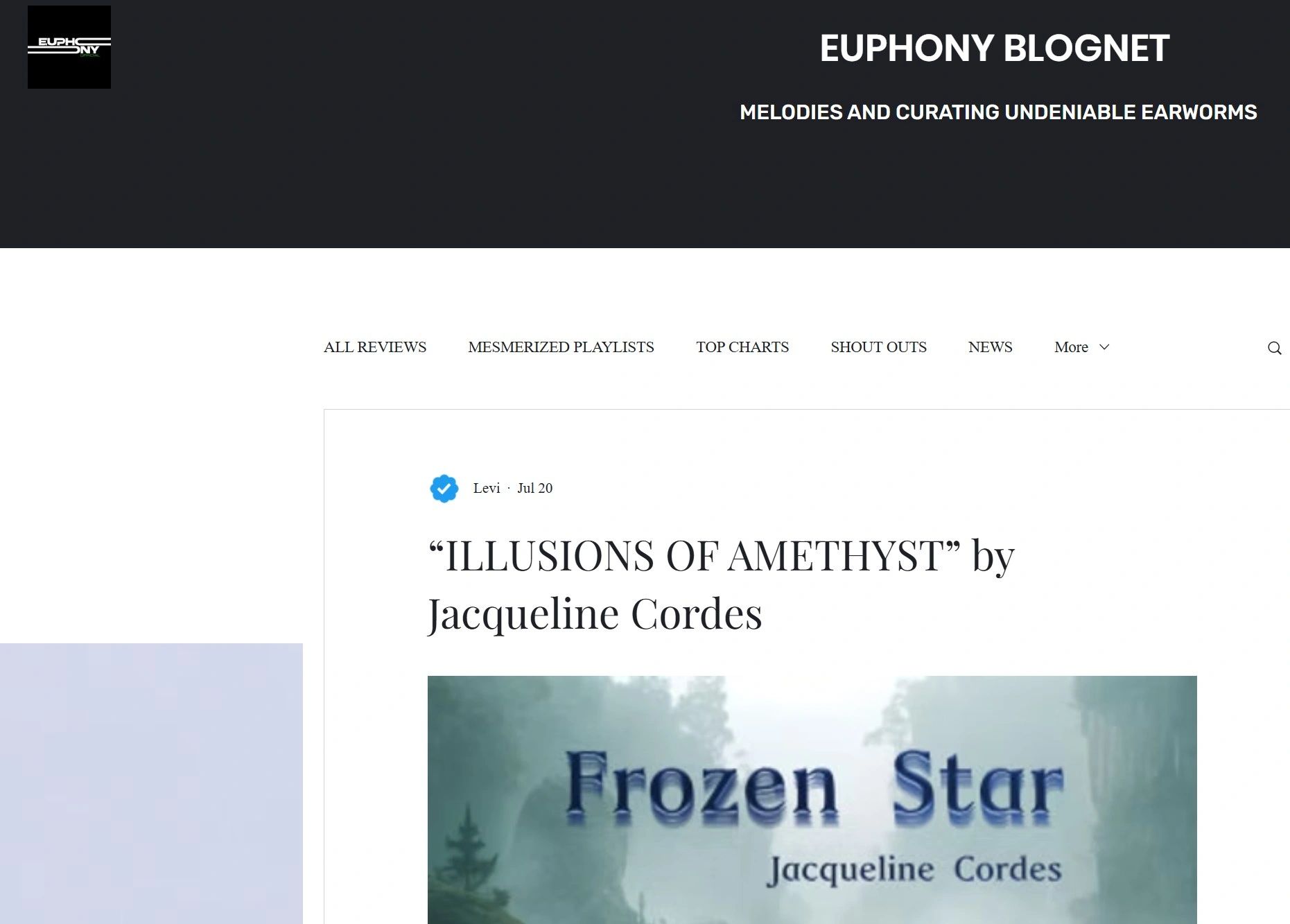
Euphony Blognet
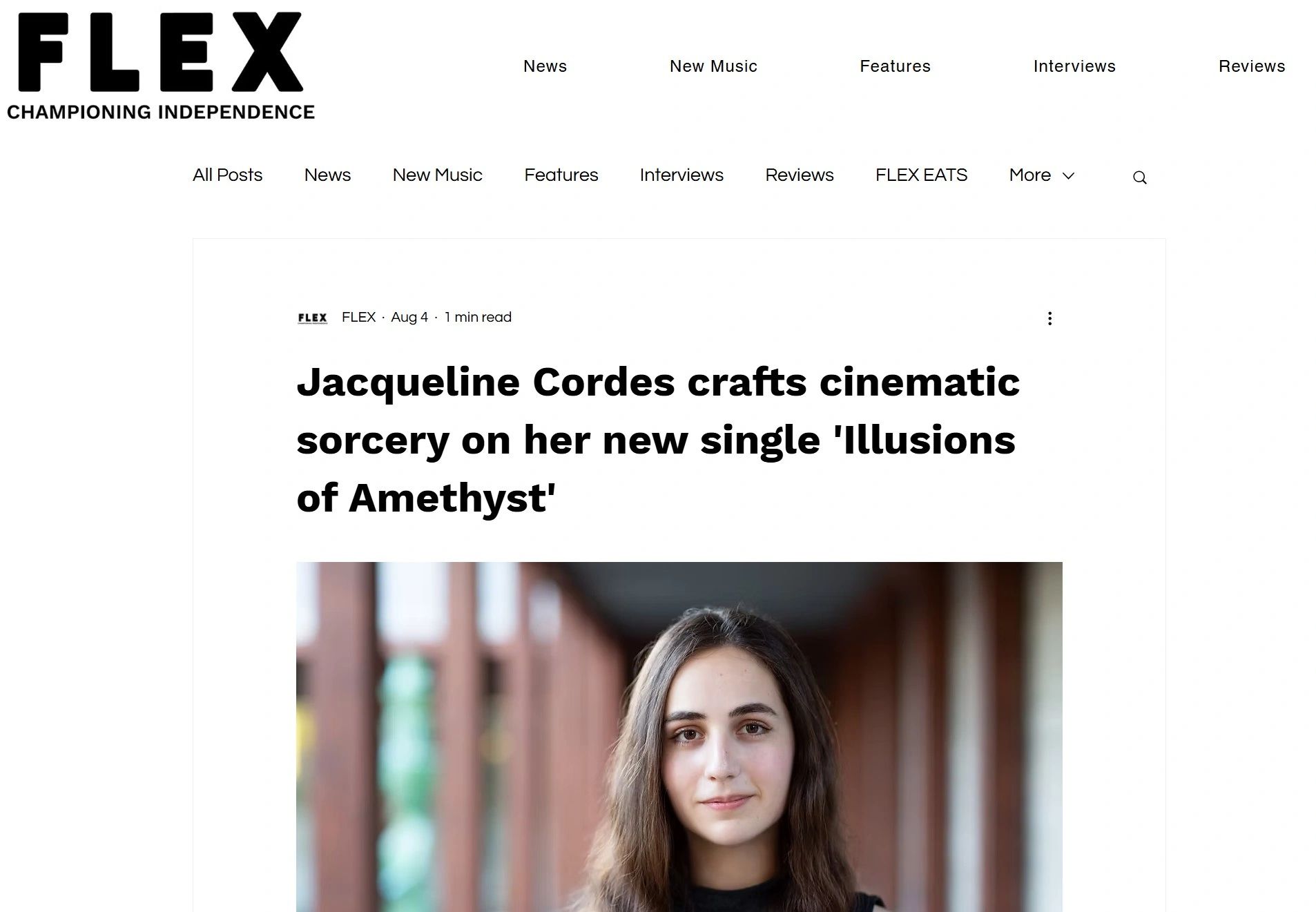
Flex Music Blog
Hail Tunes
KIMU
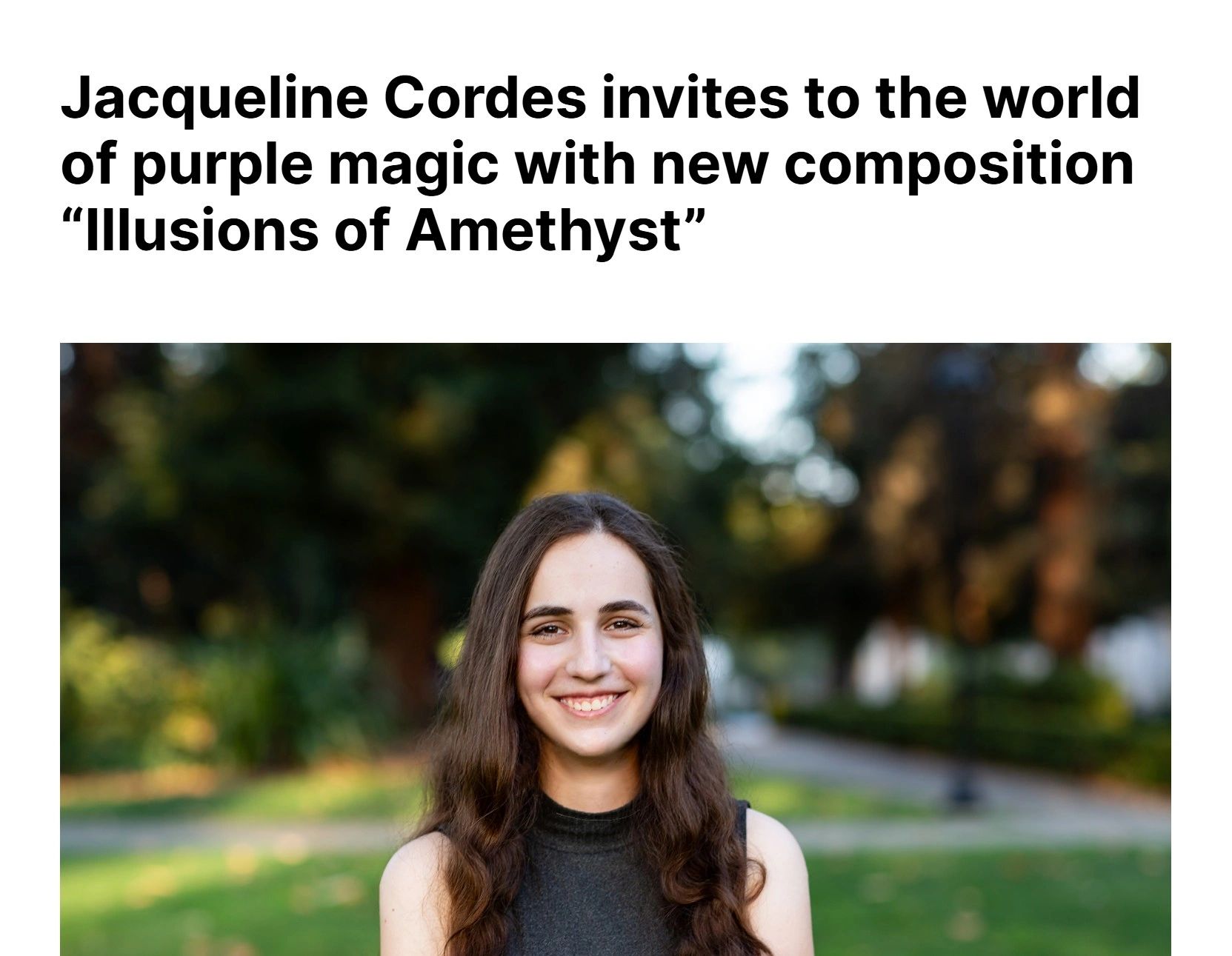
Less Than 1000 Followers
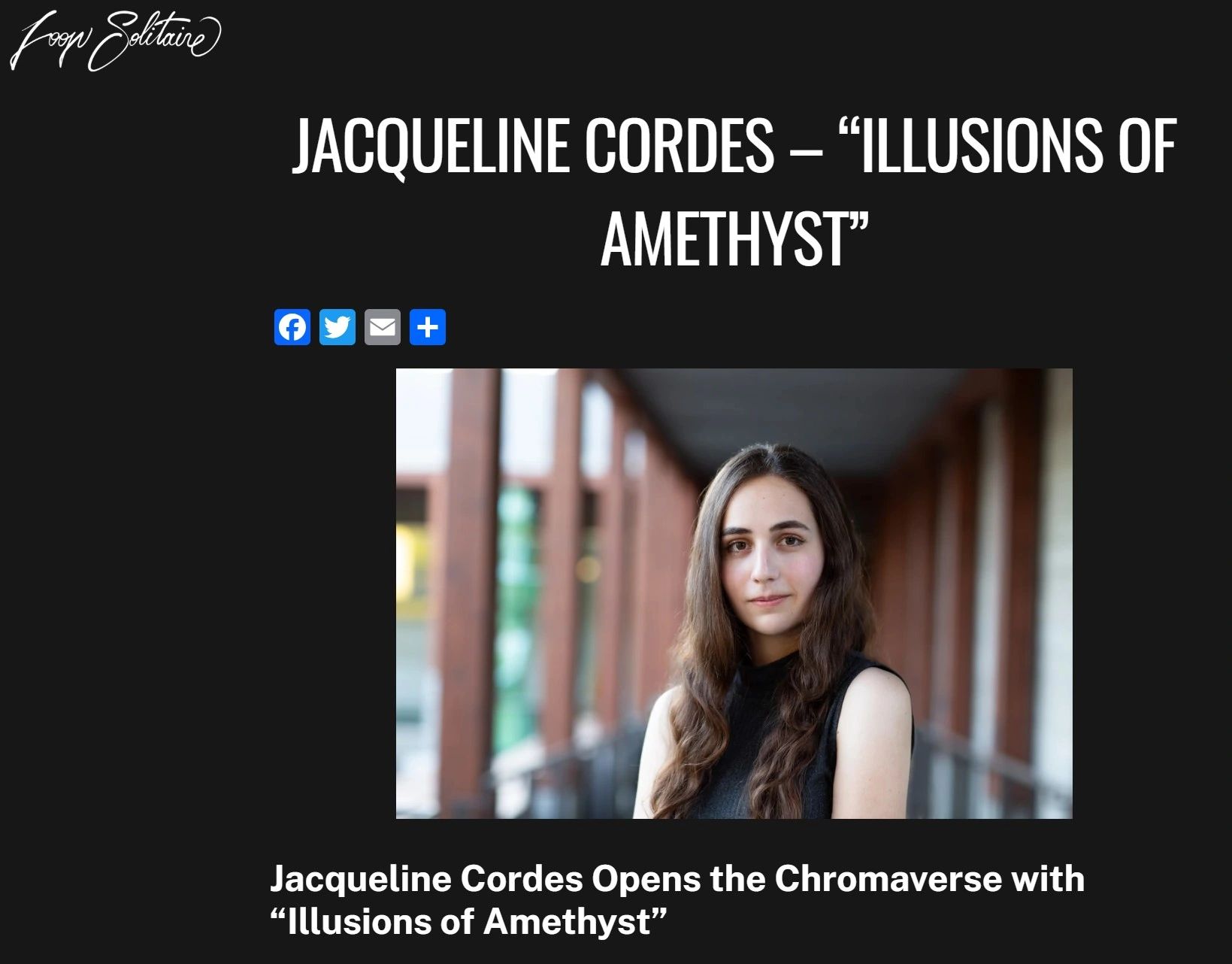
Loop Solitaire
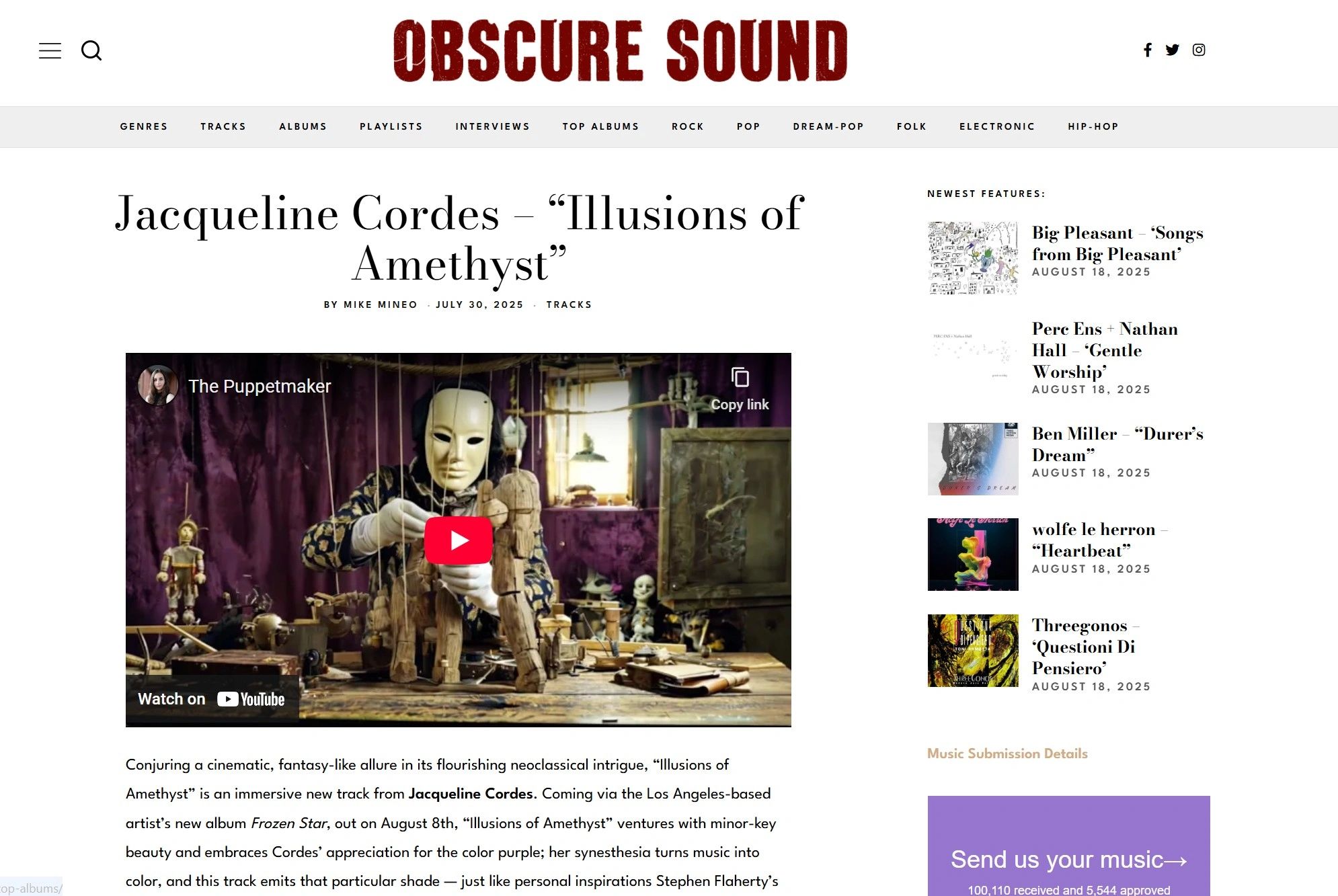
Obscure Sound
Savoy Truffle Tunes
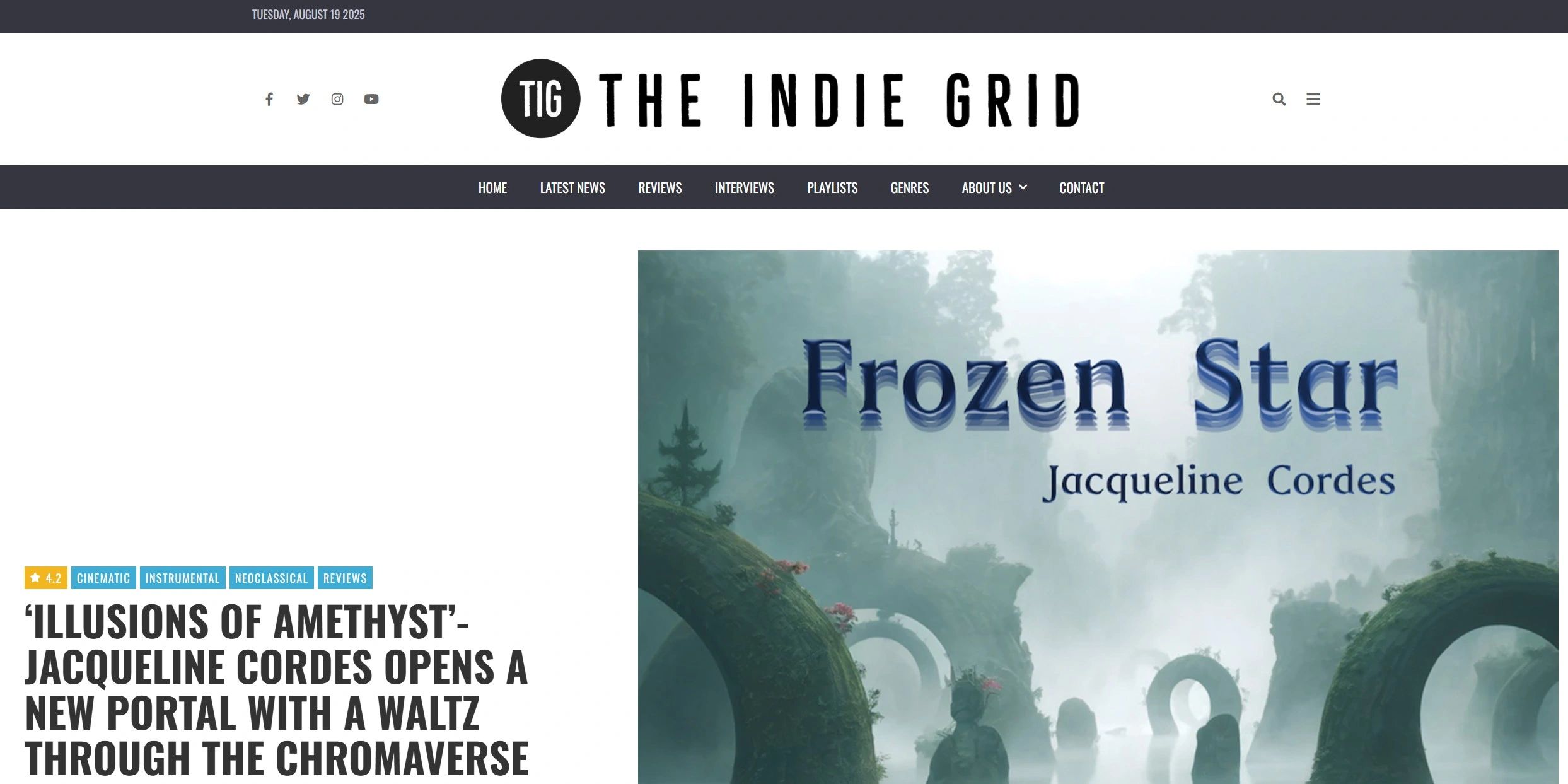
The Indie Grid
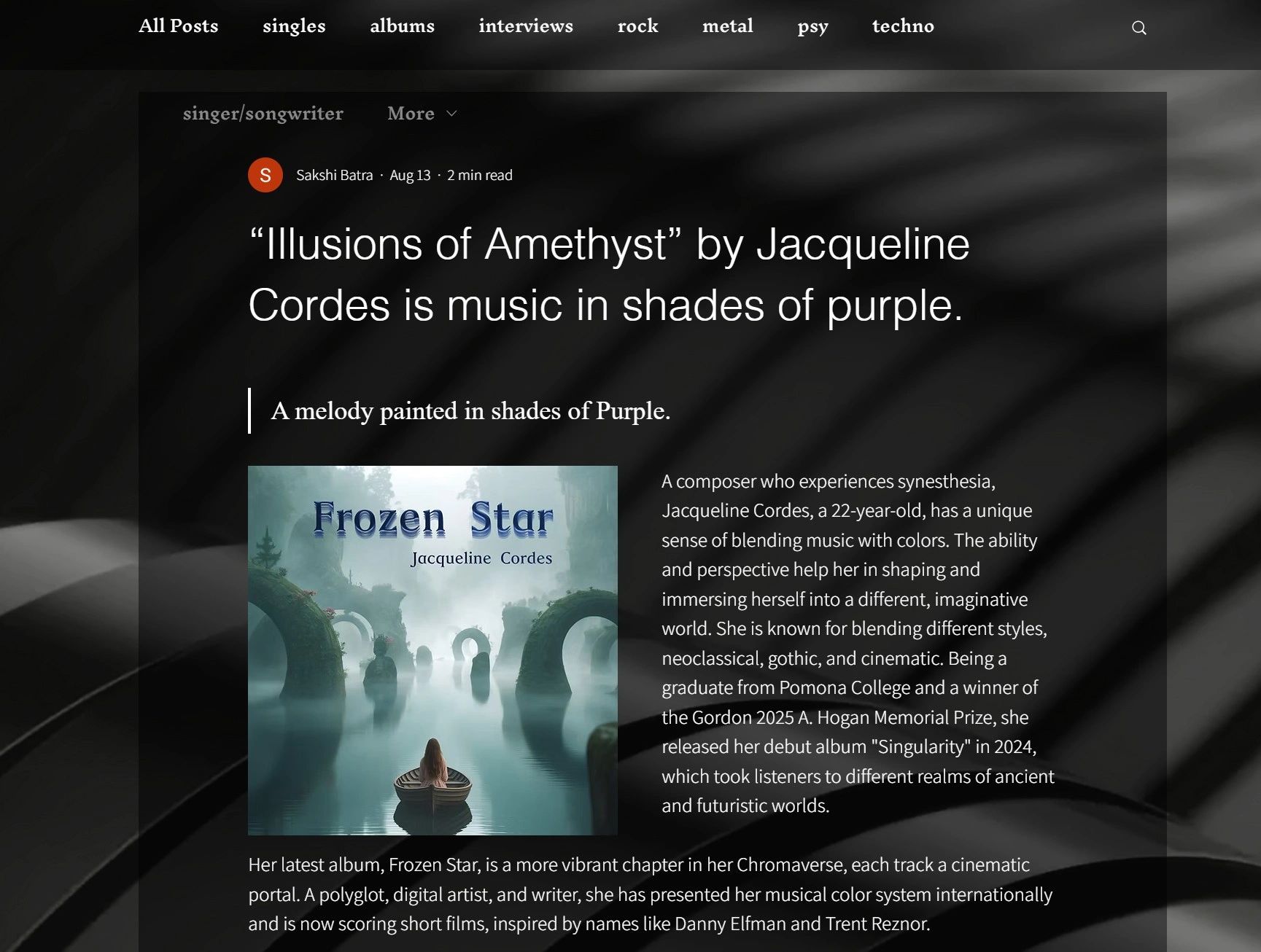
Project Timbre
Singularity Reviews
Hail Tunes
Music Balans
KIMU
Pitch Perfect
Rising Artists
Dulaxi
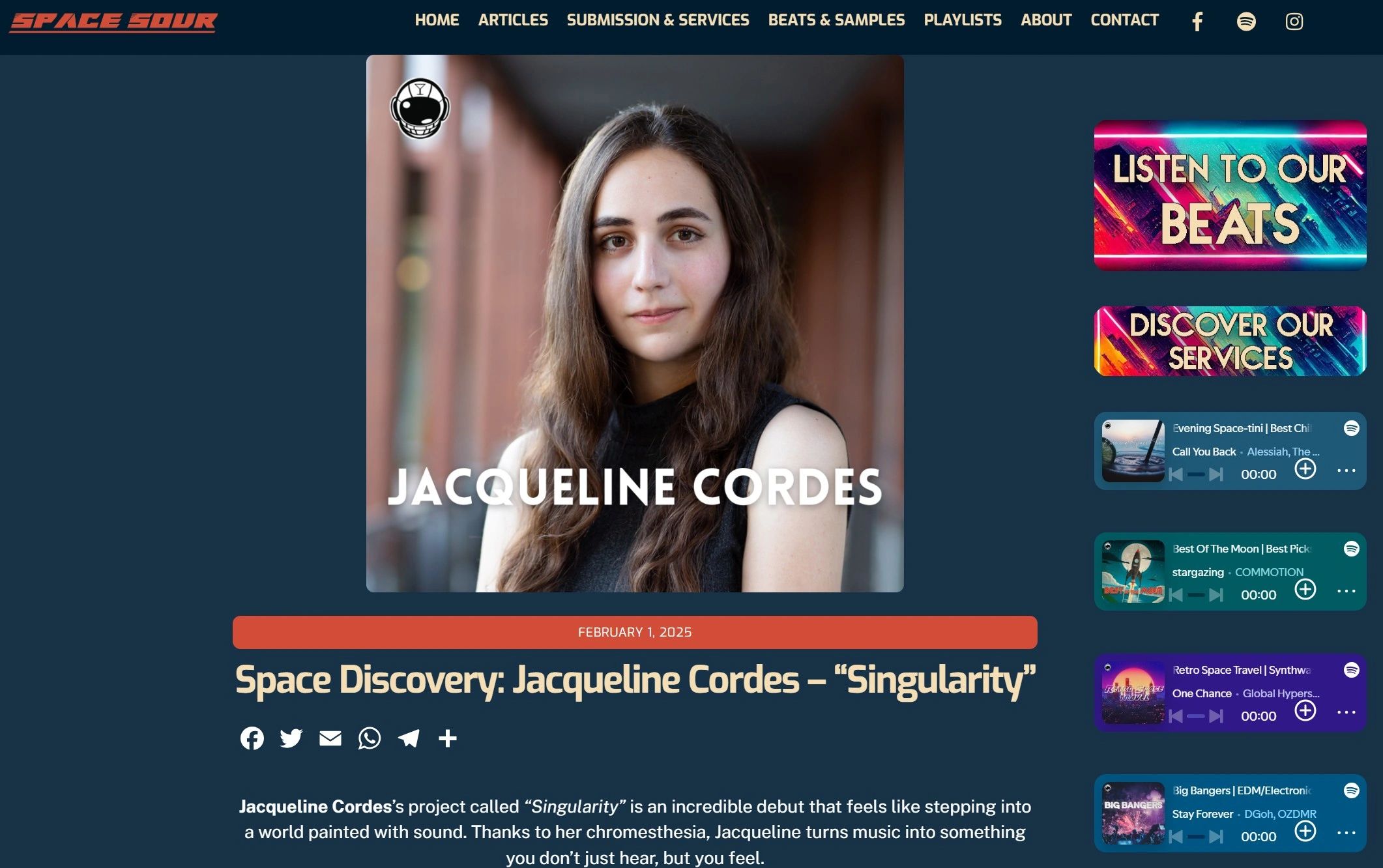
Space Sour
Each Measure
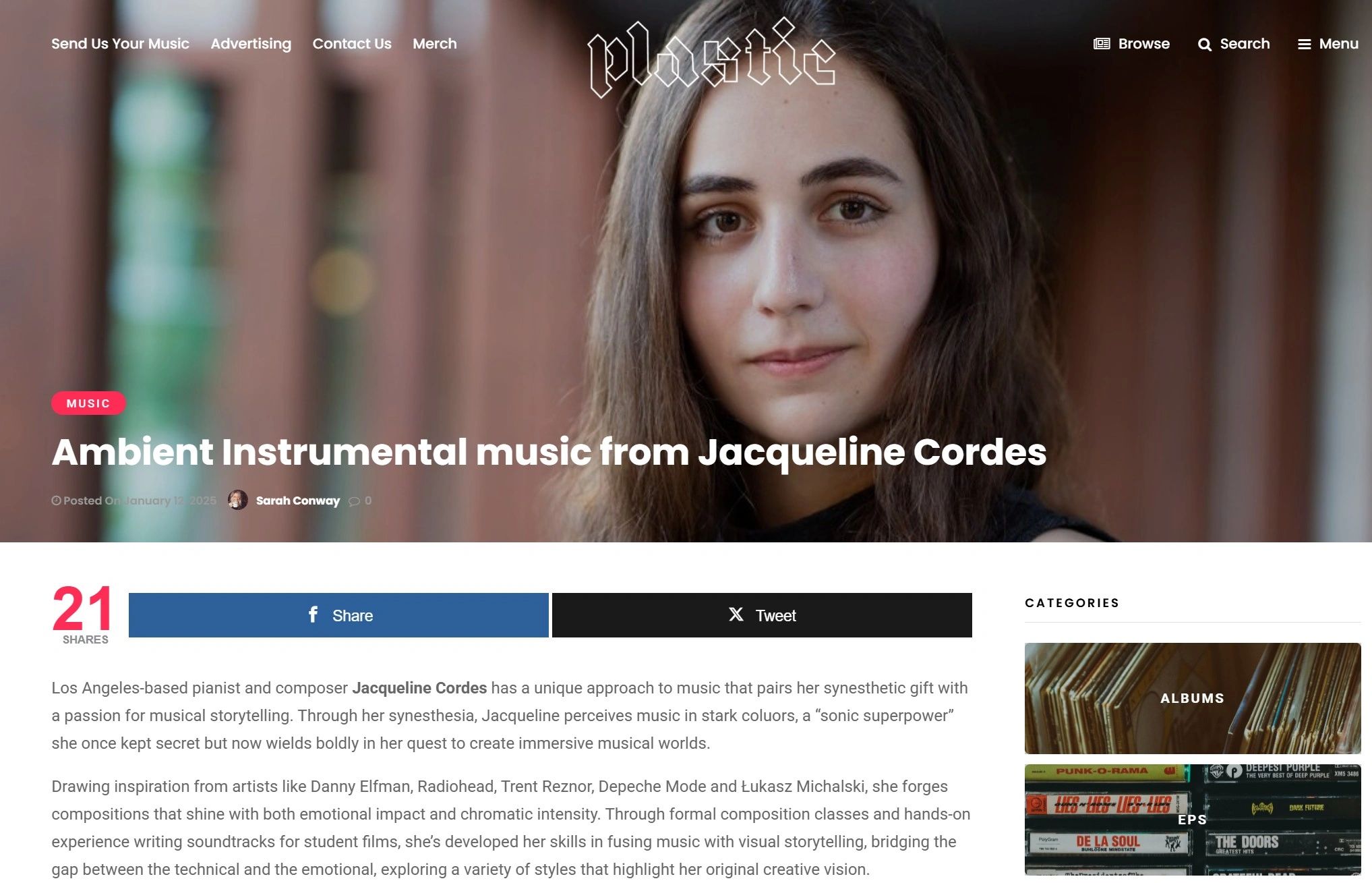
Plastic Magazine
Good Music Radar
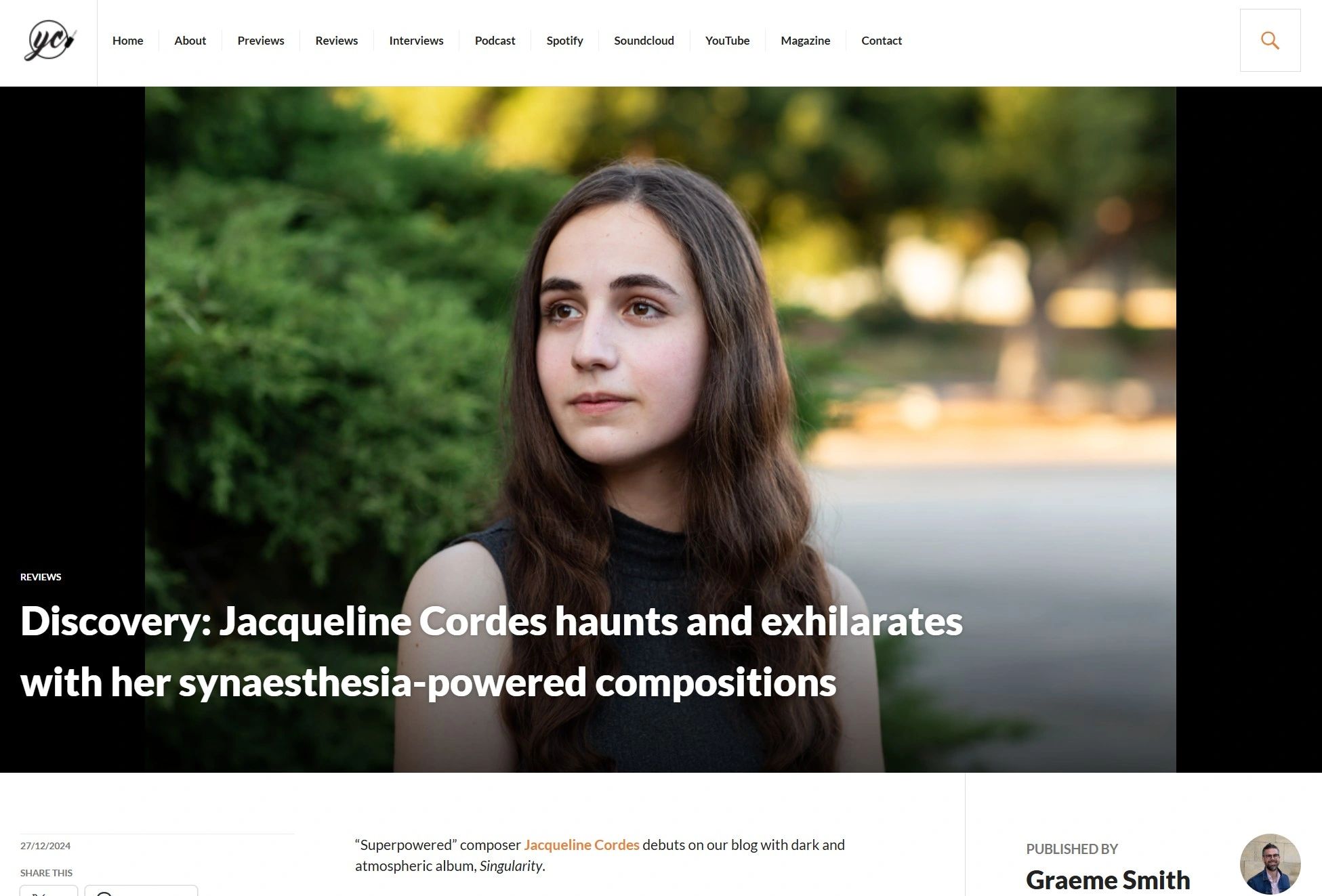
York Calling
Interviews
Claremont Courier Interview
The Feedbacker Interview
Cage Riot Interview
York Calling Interview
Plastic Magazine Interview
Claremont Courier Teenage Interview
Public Pressure Interview
Rising Artists Blog
Music, art, and professional profiles
Listen, follow, and watch the music videos.